Home » News » Application » Why Do Filters with the Same Model Number Have Different Filtration Performance?
Hot Keywords:
- All
- Product Name
- Product Keyword
- Product Model
- Product Summary
- Product Description
- Multi Field Search

Views: 11 Author: Site Editor Publish Time: 2026-11-17 Origin: Site


Filters with the same model number and similar prices do not always deliver the same filtration performance or service life. The difference may come from filter media structure, fiber characteristics, manufacturing processes, filter design, and quality control. To make a reliable purchasing decision, buyers should compare technical specifications and finished-filter performance rather than relying only on product names or prices.
When sourcing replacement filters, buyers often compare products by model number, appearance, and price. Two suppliers may offer what appears to be the same filter, but the products can perform differently after installation.
One filter may maintain stable airflow, capture dust effectively, and last longer. Another may experience a faster increase in pressure drop, reduced airflow, or a shorter service life.
Why does this happen?
The model number usually identifies a compatible product or design. It does not necessarily describe every detail of the filter media, construction, or manufacturing quality. Several factors can affect the final performance.
Customer concern: If two filters use the same material, shouldn't their performance be similar?
Why it happens: The material name alone does not define the complete filter structure. Different fiber diameters, fiber distribution, thickness, weight, and porosity can lead to different filtration characteristics.
For example:
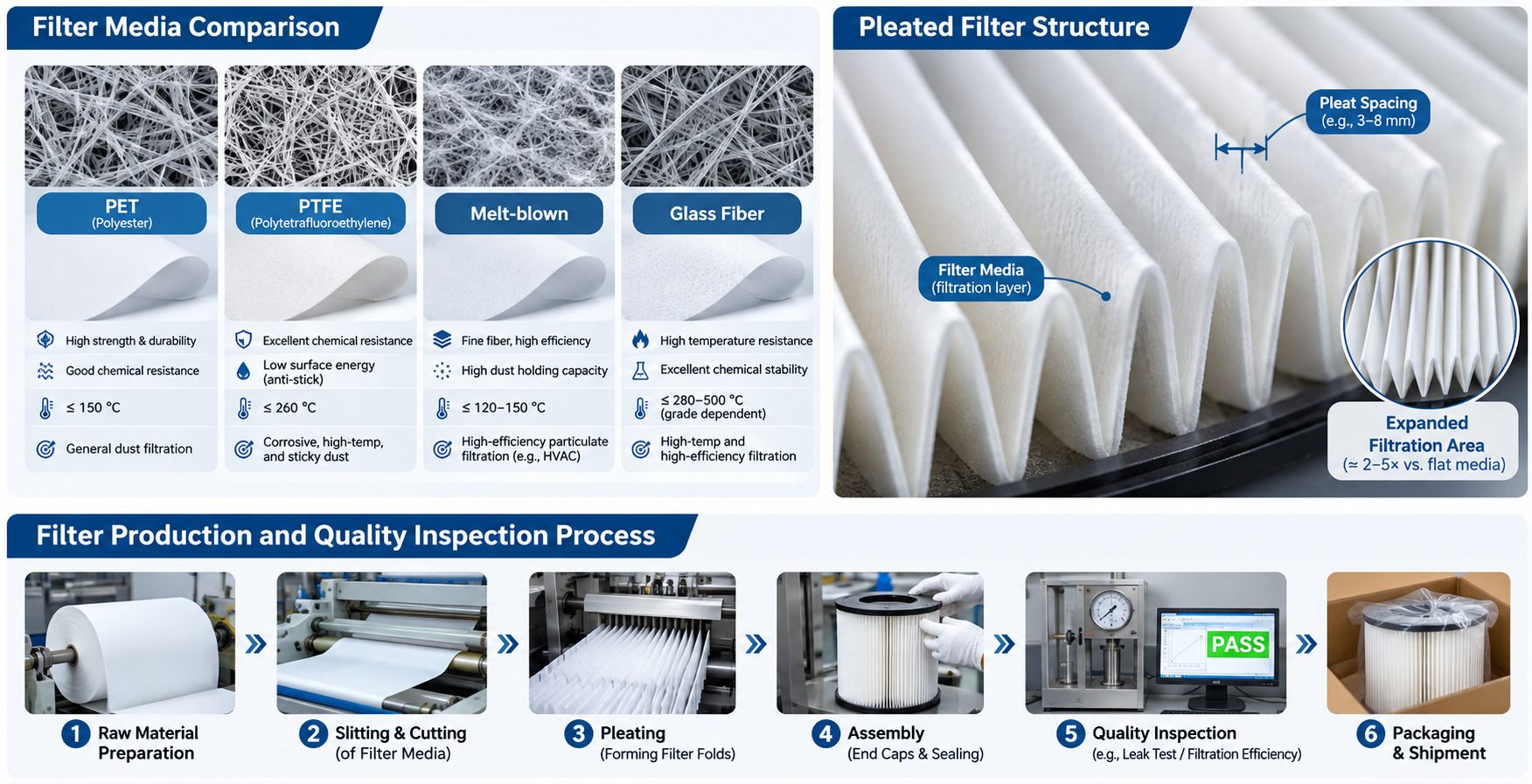
• PET (polyester): Commonly used in nonwoven fabrics and needle-punched filter felt. Its mechanical strength and dimensional stability make it suitable for various filtration applications. Actual performance depends on fiber type and fabric structure.
• PTFE (polytetrafluoroethylene): Known for chemical resistance and thermal stability. PTFE can be used as a membrane, coating, or fiber. In suitable applications, a PTFE membrane can support surface filtration and dust release.
• Melt-blown media: This is a manufacturing process rather than a material category. Polypropylene is commonly used to produce fine fibers that form a nonwoven filtration layer. Fiber diameter, layer structure, and material weight all influence performance.
• Glass fiber: Offers good thermal stability and is used in certain high-efficiency air filtration applications. However, its brittleness and processing requirements need to be considered.
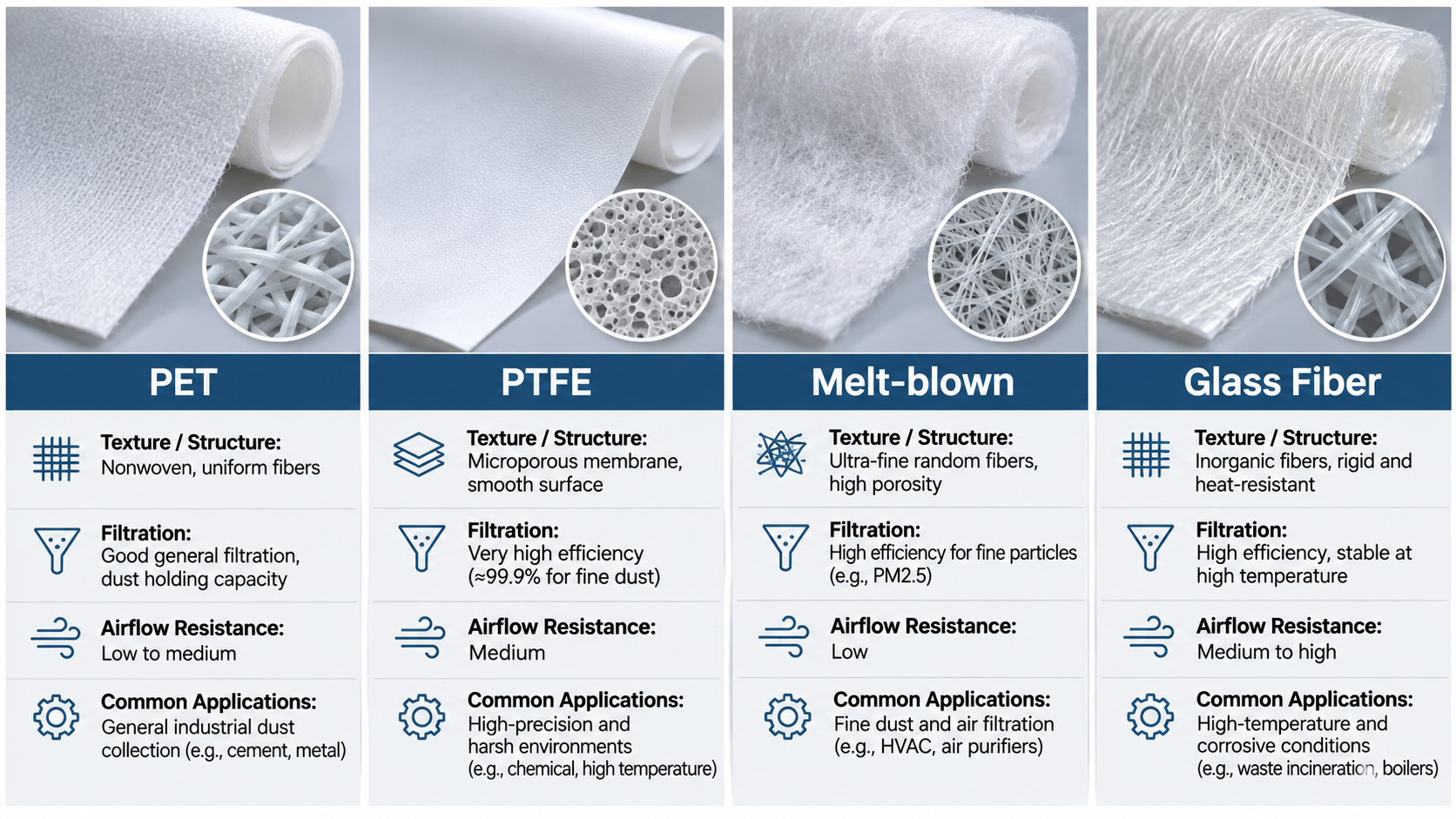
How buyers can evaluate it: Ask suppliers for the exact media type and relevant specifications, such as material composition, thickness, basis weight (GSM), and layer structure.
Important: Different materials are designed for different working conditions. The most expensive or technically advanced media is not automatically the best choice for every application.
Customer concern: Why can filters made from similar materials still have different quality?
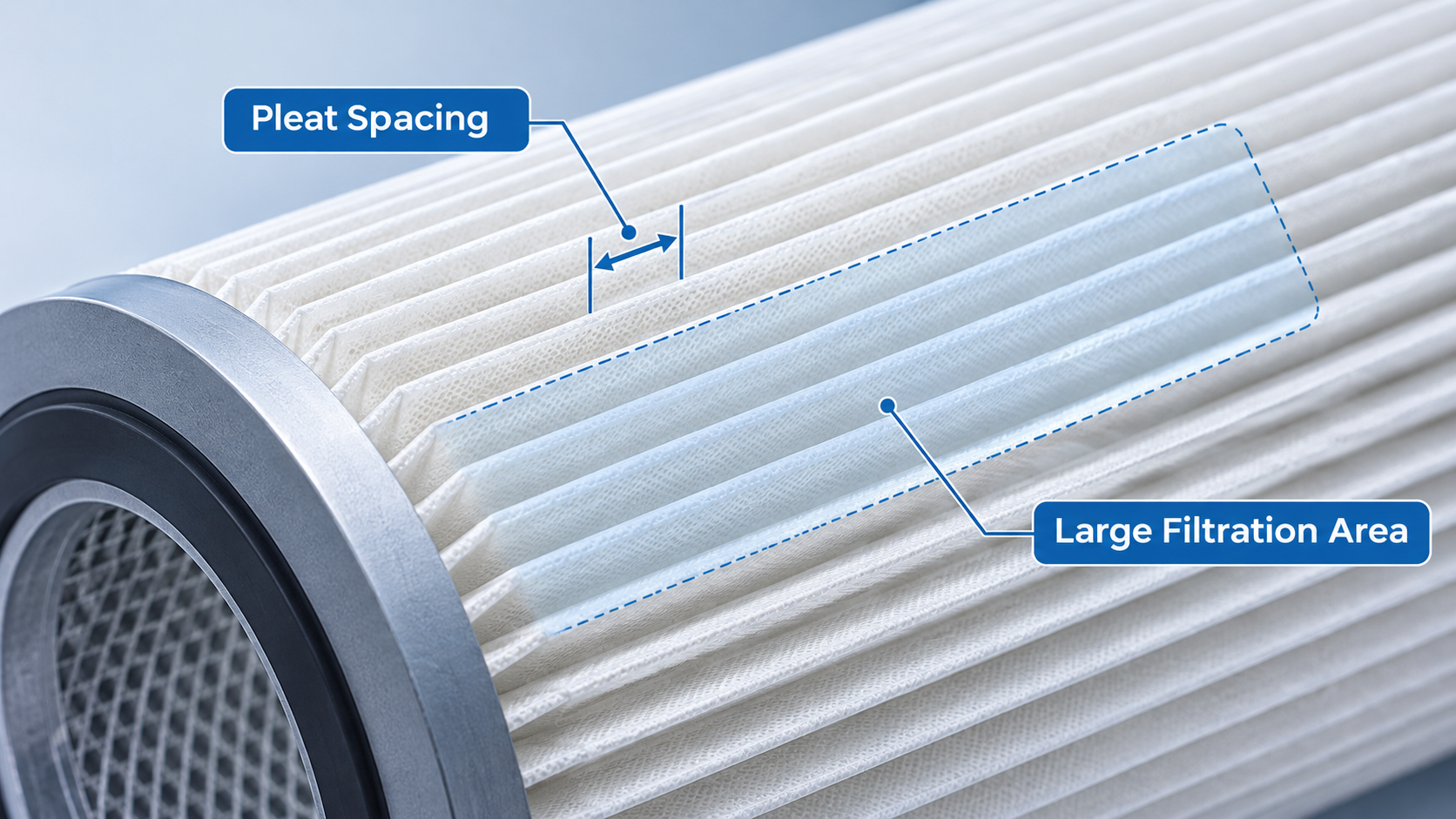
Why it happens: The production process determines how consistently the media is formed, processed, and assembled. Variations in pleating, bonding, cutting, and assembly can affect the finished filter. For pleated filters, for example, the number of pleats, pleat spacing, pleat height, and effective filtration area can influence airflow and dust holding capacity. Poor bonding or uneven pleat spacing may also create weak points. In some applications, gaps around the filter frame or end caps can allow air to bypass the filter media.
How buyers can evaluate it: Compare the finished product, not just the raw material. Check the filter dimensions, pleat arrangement, bonding quality, sealing structure, and overall workmanship.
Important: A filter with more pleats is not necessarily better. Pleat spacing and airflow distribution also matter.
Customer concern: Does higher filtration efficiency always mean a better filter?
Why it happens: Filtration efficiency is only one part of filter performance. Air permeability, airflow resistance, and pressure drop also affect how a filter operates. A filter designed to capture finer particles may create greater airflow resistance if its structure is not properly designed. This can affect equipment operation and energy consumption.For this reason, buyers should evaluate filtration efficiency together with initial pressure drop and airflow under comparable test conditions.
How buyers can evaluate it: Request test data that identifies the test method, airflow, particle size, filtration efficiency, and pressure drop. Make sure the products are tested under comparable conditions.
Important: Test results from different methods or conditions should not be compared directly. A single efficiency figure does not tell the whole story.
Customer concern: Why can the same supplier deliver filters with inconsistent performance?
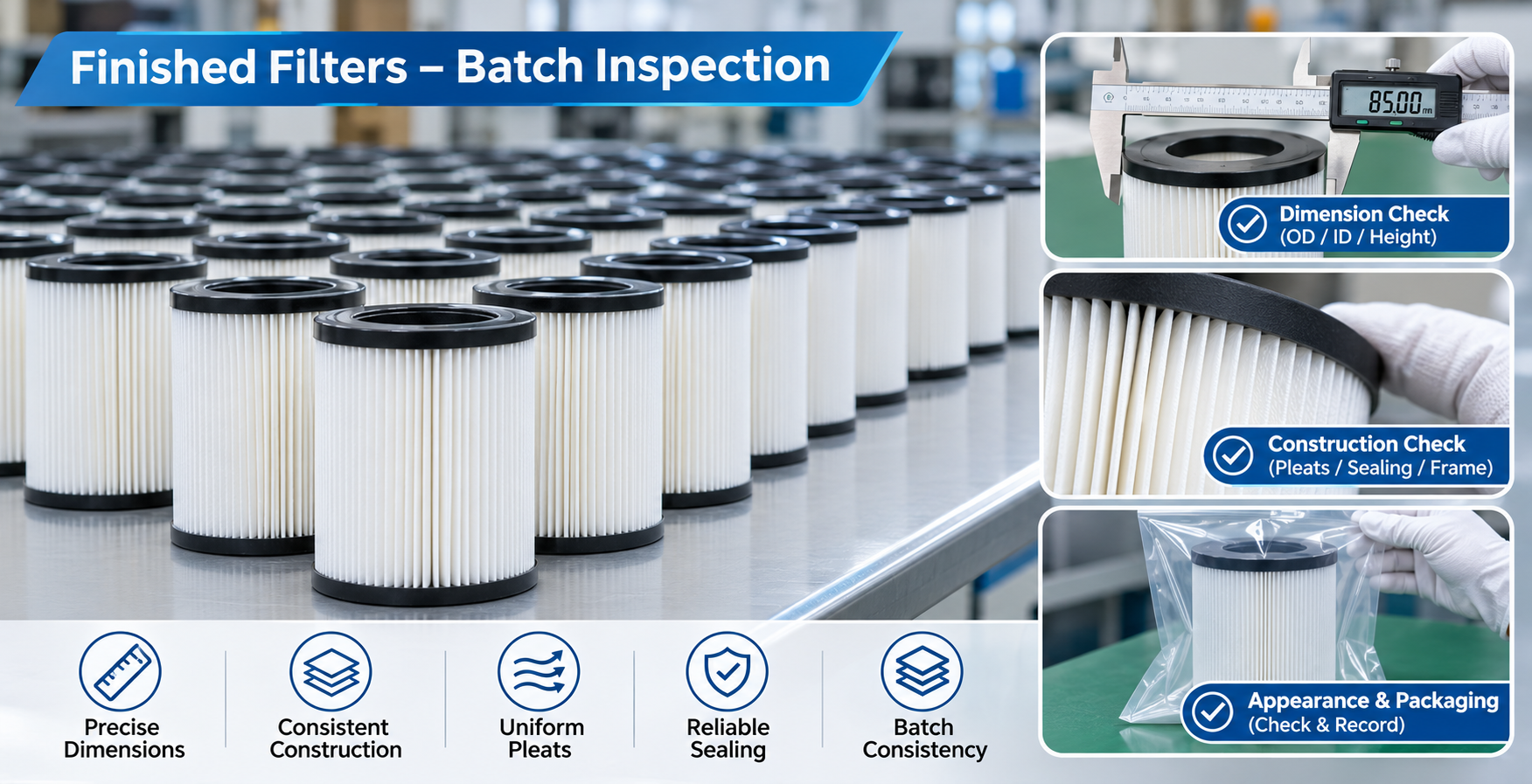
Why it happens: Even when the product design remains unchanged, variations in incoming materials and production processes can affect batch consistency. Reliable manufacturing requires checks at different stages, including raw material inspection, production monitoring, dimensional inspection, and finished-product testing where applicable.
How buyers can evaluate it: Ask suppliers how they control material consistency, product dimensions, bonding, sealing, and finished-filter quality. For important applications, request relevant inspection records or test reports.
Important: A sample can demonstrate product quality, but consistent production control is also important when placing repeat orders.
Instead of comparing only model numbers and prices, buyers can use the following checklist to evaluate whether two filters are genuinely comparable.
| Comparison Item | What to Check |
| Dimensions | Length, width, height, and other installation dimensions |
| Filter Material | PET, PTFE, polypropylene, glass fiber, or a specified combination |
| Media Structure | Thickness, basis weight, fiber structure, and layer configuration |
| Filtration Performance | Efficiency, airflow, and pressure drop under comparable test conditions |
| Construction | Pleat design, bonding, frame, end caps, and sealing |
| Dimensional Tolerance | Confirmed manufacturing tolerance for key dimensions |
| Lead Time | Production and delivery schedule |
| MOQ | Minimum order quantity and order flexibility |
The best comparison is based on the same application, operating conditions, and test methods. This helps buyers understand whether a price difference reflects a real difference in product specifications.
1.Does the same filter model number guarantee the same filtration performance?
No. The model number may indicate compatibility, but it does not guarantee identical filter media, construction, or manufacturing quality.
2.Is a more expensive filter always better?
Not necessarily. The right filter depends on the application, required filtration efficiency, airflow, operating conditions, and expected service requirements.
3.Can I compare filters by material name alone?
No. Buyers should also compare material structure, thickness, weight, fiber characteristics, and relevant performance data.
4.What information should I provide when requesting a filter quotation?
The original part number, product dimensions, application, operating conditions, required performance, and estimated order quantity are useful starting points. Drawings or product samples can also help suppliers evaluate compatibility.
Two filters may share the same model number and have similar prices, but that does not mean they offer the same value. Filter media structure, manufacturing processes, finished-product design, and quality control all contribute to filtration performance and service life.
For buyers, the key is to look beyond the model number and compare the technical details that matter to the actual application.
If you are evaluating a replacement filter or comparing products from different suppliers, you can share the part number, dimensions, drawings, or application details with our team. We can help review the specifications and identify the key points that should be compared before making a purchasing decision.
Please feel free to send your inquiry to sales@bluesky-filter.com.

If you want to see our updates in real time on social media, you can follow the following accounts.
LinkedIn: linkedin.com/company/blueskyfilter
Twitter: twitter.com/blueskyfilter
Facebook: www.facebook.com/blueskyfilter.manufacturer/
Youtube: www.youtube.com/@blueskyfilter
Instagram: https://www.instagram.com/nanjingblueskyfilters/


