Hot Keywords:
- All
- Product Name
- Product Keyword
- Product Model
- Product Summary
- Product Description
- Multi Field Search

Views: 50 Author: Melody Publish Time: 2026-09-07 Origin: Site


Filter pressure drop is the difference in static pressure measured before and after air passes through an air filter. It represents the resistance the filter creates against airflow.
Pressure drop depends on factors such as filter media, filtration efficiency, media area, pleat design, filter depth, airflow rate and dust loading. As a conventional media filter collects particles, its resistance generally increases.
For HVAC systems, pressure drop matters because the fan must move air through the filter while maintaining the required airflow. A suitable filter therefore needs to balance filtration efficiency, airflow and resistance, rather than simply providing the highest possible filtration efficiency.
Air filtration efficiency is often the first specification buyers compare when selecting an HVAC filter. However, efficiency alone does not describe how the filter will interact with the ventilation system.
Air must pass through the filter media before it can continue through the air-handling system. During this process, the filter creates airflow resistance. The resulting difference in static pressure between the upstream and downstream sides of the filter is called filter pressure drop.
Understanding pressure drop is particularly important for commercial HVAC systems, air handling units, industrial ventilation systems and multi-stage filtration installations. Excessive resistance can affect airflow and fan performance, while insufficient filtration may fail to achieve the required air-cleanliness target.
For HVAC contractors, facility managers, distributors and OEM buyers, pressure drop is therefore one of the key specifications to evaluate alongside filtration efficiency, rated airflow, dimensions and filter structure.

What Is Filter Pressure Drop?
How Is Filter Pressure Drop Measured?
Why Does Filter Pressure Drop Matter?
What Causes Filter Pressure Drop?
How Does Dust Loading Affect Pressure Drop?
Does Higher MERV Mean Higher Pressure Drop?
How Does Filter Structure Affect Resistance?
Initial Pressure Drop vs Final Pressure Drop
How To Select an HVAC Filter Based on Pressure Drop
Why Similar-Efficiency Filters Can Perform Differently
What Should B2B Buyers Check?
HVAC Filter Solutions for Different Airflow Requirements
Common Pressure Drop Mistakes
Frequently Asked Questions
Conclusion
Filter pressure drop is the difference in static pressure across an air filter while air is flowing through it.
ASHRAE refers to this characteristic as resistance to airflow and notes that static pressure differential, pressure drop and resistance are commonly used interchangeably in this context.
A simplified airflow path looks like this:
Upstream Air → Filter Media → Downstream Air
The upstream side has a higher static pressure because the filter creates resistance as air moves through its fibers and internal structure.
The greater the resistance under the same airflow conditions, the greater the pressure drop.
This does not mean resistance is inherently bad. Any mechanical particle filter needs some structure capable of capturing particles. The engineering goal is to obtain the required filtration performance without creating unnecessary resistance.
Pressure drop is determined by measuring static pressure on both sides of the filter.
The measurement typically compares:
Upstream static pressure
Downstream static pressure
Airflow through the filter
The difference between upstream and downstream static pressure is the filter pressure drop.
Common units include:
Pa, or Pascals
in. w.g., or inches of water gauge
A pressure-drop value should always be evaluated together with the airflow at which it was measured.
For example, a filter tested at a lower airflow cannot be fairly compared with another filter tested at a substantially higher airflow simply by looking at the pressure-drop number.
ASHRAE Standard 52.2 evaluates air-cleaning devices at defined airflow conditions and reports both particle-removal performance and resistance to airflow. The current published version is ANSI/ASHRAE Standard 52.2-2025.
Pressure drop affects not only the filter but also the HVAC system around it.
Every HVAC fan has a limited ability to overcome system resistance.
The total system resistance can come from:
Filters
Ductwork
Coils
Dampers
Grilles
Other air-handling components
If the filter creates more resistance than the system is designed to handle, airflow may decrease.
For applications that require a specified ventilation rate, reduced airflow can negatively affect system performance.
In some HVAC systems, controls may increase fan output to maintain the required airflow as filter resistance rises.
This means the fan may need to operate against a greater static pressure.
In systems that cannot compensate, airflow may instead fall.
For this reason, both the clean-filter resistance and the final operating resistance should be compatible with the HVAC system and fan capacity.
Filter resistance can also influence operating energy.
When a fan must overcome greater resistance to maintain airflow, additional energy may be required depending on the fan and control system.
This means the lowest purchase price does not necessarily result in the lowest overall filtration cost.
Filter selection should also consider:
Service life
Energy use
Replacement frequency
Maintenance requirements
Dust-holding capacity
ASHRAE identifies resistance to airflow and life-cycle cost as important characteristics when evaluating air-cleaning devices.
Choosing the lowest-resistance filter is not automatically the correct solution either.
A very open filter may allow excellent airflow but fail to capture the particle sizes required by the application.
The practical goal is:
Required Filtration Efficiency + Suitable Airflow + Acceptable Pressure Drop
These three factors should be evaluated together.
Filter pressure drop is influenced by the complete filter design rather than one specification alone.
The characteristics of the media influence both particle capture and airflow resistance.
Important factors include:
Fiber diameter
Fiber density
Media thickness
Pore structure
Media technology
Finer or denser filtration structures can create additional resistance, although advanced media design can help improve the balance between efficiency and airflow.
Media area is one of the most important filter-design variables.
If the same airflow is distributed over a larger effective filtration area, the velocity through the media can be reduced.
This principle is why many HVAC filters use extended-surface designs.
ASHRAE specifically identifies:
Pleated panels
Mini-pleat filters
Bag or pocket filters
Compact extended-surface filters
as structures that increase media area to help achieve greater filtration performance while controlling resistance.
Pleating allows manufacturers to place more filter media inside a limited frontal area.
However, more pleats do not automatically mean better performance.
Important variables include:
Pleat depth
Pleat spacing
Pleat quantity
Media support
Air distribution
If pleats are packed too closely, airflow between adjacent surfaces may become restricted.
Good pleat design therefore needs to balance media area with sufficient space for air to enter and leave the pleat channels.
A deeper filter provides more physical space for additional media or deeper pleats.
This can allow a manufacturer to increase filtration area without increasing the frontal dimensions of the filter.
However, a deeper filter is not automatically a lower-resistance filter.
Actual performance still depends on:
Media
Pleat geometry
Airflow
Efficiency requirement
Overall construction
Pressure drop changes with airflow.
When more air is forced through the same filter, resistance generally increases.
This is why technical comparisons should always use pressure-drop values measured under comparable airflow conditions.
For conventional fibrous media filters, pressure drop normally increases as particles accumulate.
The process can be understood as:
Clean Filter → Particle Collection → Reduced Open Airflow Paths → Increased Resistance
As dust collects within and on the filter media, some of the available pathways for air become more restricted.
ASHRAE Standard 52.2 includes standardized dust-loading stages so that changes in filter performance and resistance can be evaluated as the filter becomes loaded.
This means a filter's resistance is not necessarily constant throughout its service life.
A new filter has an initial pressure drop, while a loaded filter normally operates at a higher resistance.
A filter that looks dirty is not automatically at the end of its service life.
Likewise, a filter that looks relatively clean may already contain fine dust within the media.
For suitable commercial HVAC installations, filter condition can be monitored using equipment such as:
Differential pressure gauges
Manometers
Pressure sensors or transducers
ASHRAE notes that resistance monitoring can be used to identify when media filters require service or replacement.
Not necessarily.
Higher filtration efficiency can increase airflow resistance under equivalent conditions, but the MERV rating alone does not determine pressure drop.
Actual resistance also depends on:
Media technology
Effective media area
Filter depth
Pleat geometry
Face velocity
Rated airflow
Filter construction
ASHRAE notes that as filtration efficiency increases, resistance often increases at the same airflow rate. It also explains that manufacturers can increase exposed media area to achieve higher efficiency while maintaining pressure drop within HVAC design limits.
This distinction is important.
Two MERV 13 filters can have different pressure-drop characteristics.
Likewise, a well-designed filter with a larger effective media area may provide higher filtration efficiency without creating proportionally higher resistance.
For buyers, the correct approach is to compare:
Efficiency Rating + Rated Airflow + Pressure Drop
rather than comparing MERV ratings alone.
MERV vs HEPA Filters: What's the Difference and Which One Should You Choose?
This article can be internally linked here.
Different HVAC filter structures use different methods to increase filtration area and manage airflow.
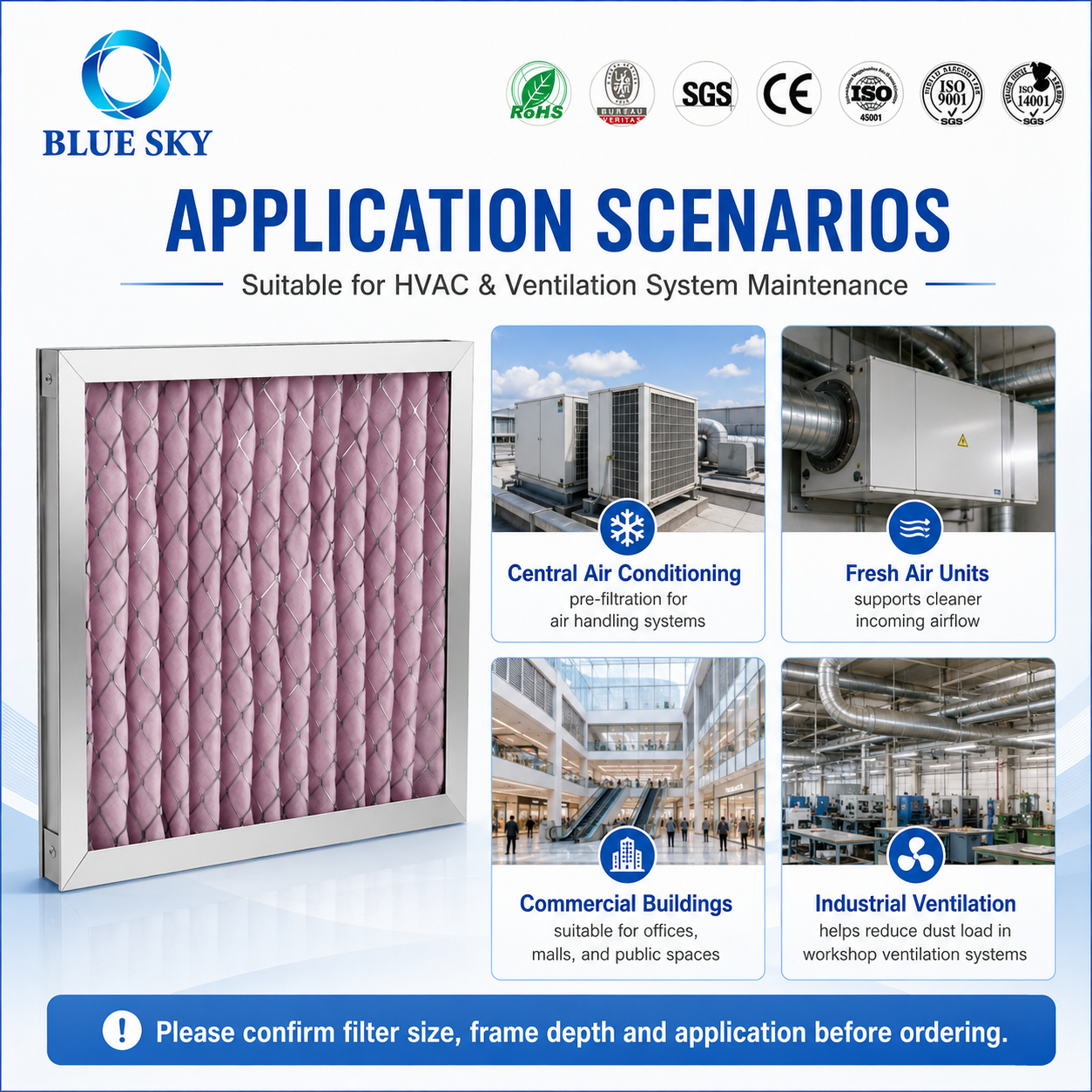
A pleated filter folds the media repeatedly inside the frame.
The structure allows substantially more media to fit inside the filter than a flat sheet of the same frontal dimensions.
Pleated filters are commonly used in:
Residential HVAC
Commercial ventilation
Air handling units
General industrial ventilation
The final pressure drop depends on media type, pleat geometry, filter depth and operating airflow.
Blue Sky Filter currently offers customizable pleated HVAC filter structures with different dimensions, media and filtration grades.

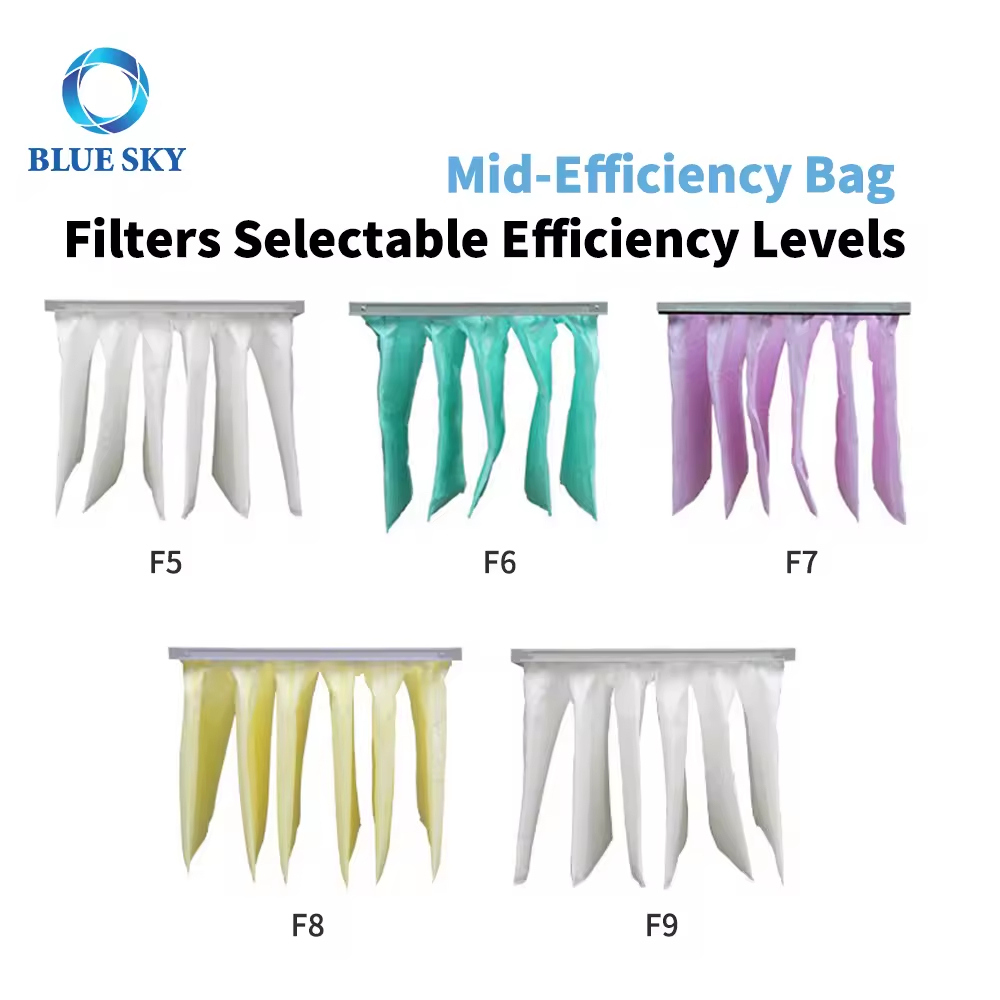
Pocket filters extend multiple bags downstream from the filter frame.
This creates a large effective filtration area within the HVAC system.
Pocket filters are frequently used as a Medium Efficiency Filter for:
Fresh-air systems
Commercial HVAC
Industrial ventilation
Intermediate filtration
Pre-filtration before higher-efficiency filters
Blue Sky Filter pocket products use configurable pocket structures, synthetic or other filter media and different frame materials. Existing product specifications also show that resistance varies with airflow and efficiency grade, illustrating why airflow and pressure drop should be considered together.

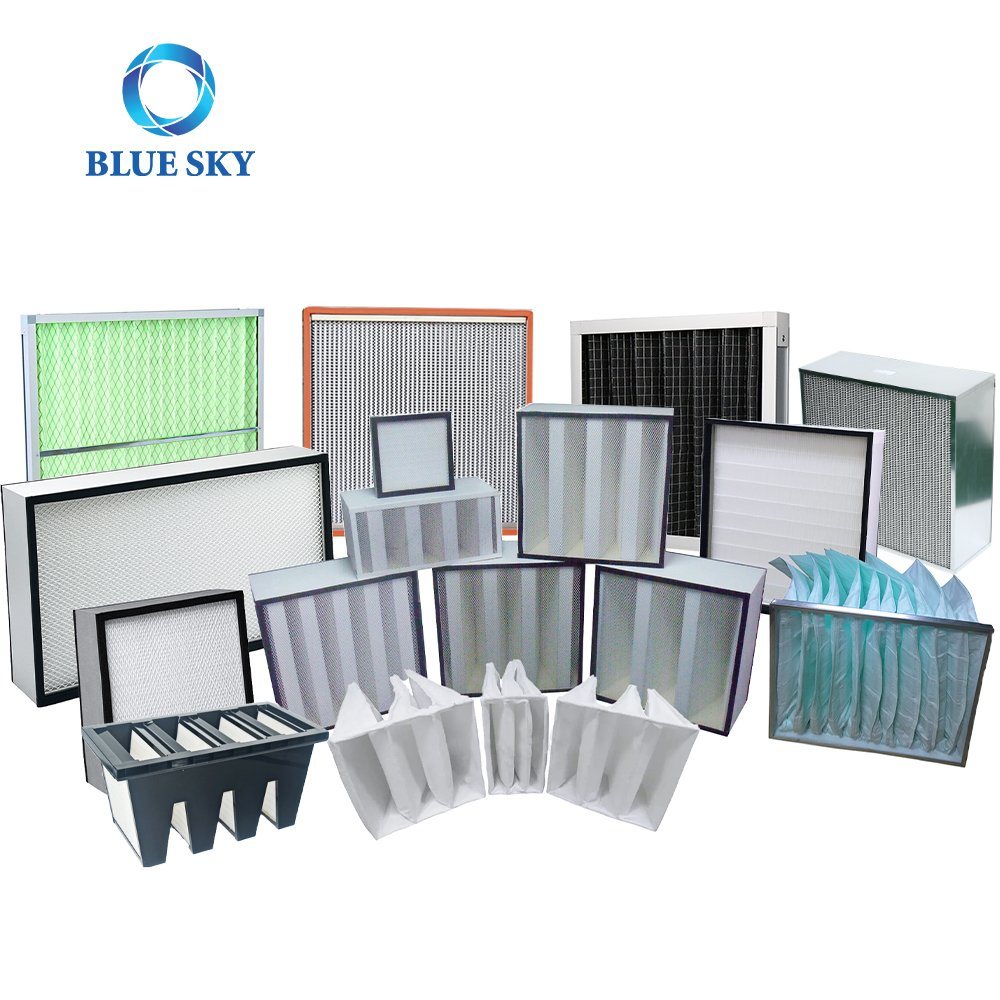
HEPA filtration requires substantially higher particle-removal performance than ordinary general-ventilation filters.
Because of the required media performance, airflow resistance becomes an especially important design consideration.
HEPA structures may use:
Mini-pleat media
Deep pleats
Rigid boxes
High-media-area configurations
A HEPA filter should therefore not be installed simply because a higher filtration efficiency is desired.
The HVAC system must also be able to accommodate its airflow requirements and resistance.

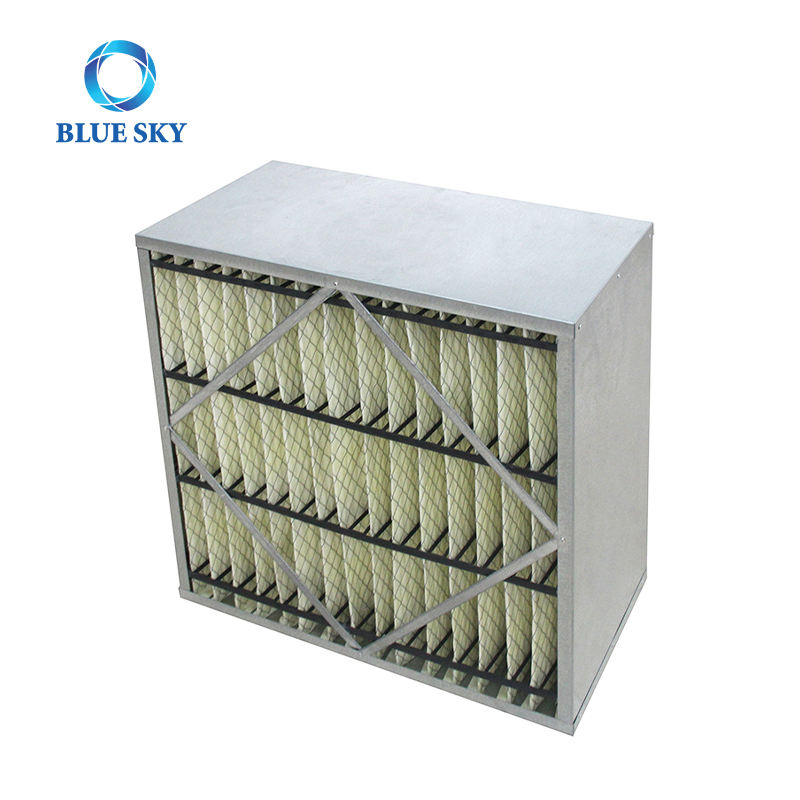
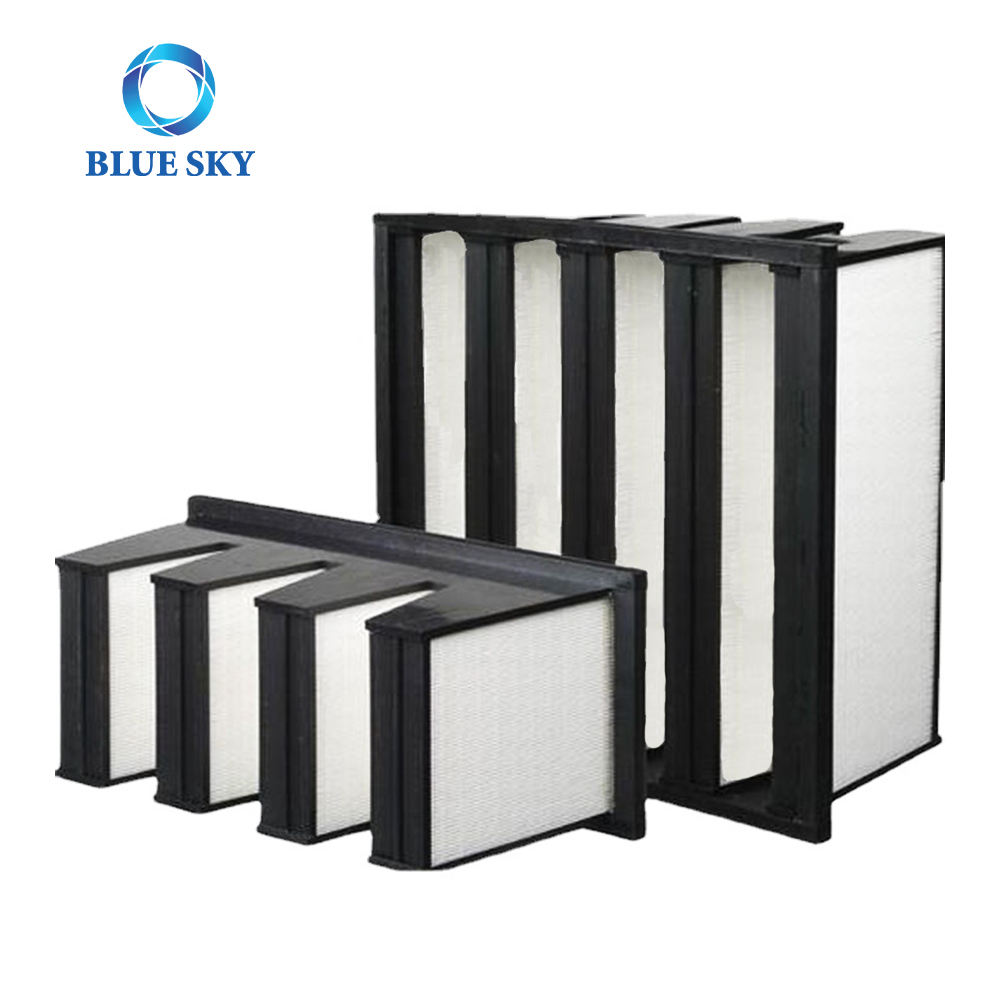
V-bank filters arrange multiple filter packs in a V-shaped configuration.
This structure allows manufacturers to install a larger amount of media inside a relatively compact filter depth.
The increased media area can be useful where an application needs a combination of:
High airflow
High filtration efficiency
Compact installation space
The concept illustrates an important principle in filter engineering:
Increasing useful filtration area can help balance efficiency and airflow resistance.
These two terms describe different stages of filter operation.
Initial pressure drop is the airflow resistance of a new, clean filter under specified airflow conditions.
It provides a baseline for comparing filters.
When comparing products, buyers should ensure that the airflow and test conditions are comparable.
Final pressure drop refers to a predetermined maximum operating resistance used as a filter service or replacement criterion.
It is not a universal value for every filter.
The suitable final pressure drop depends on:
Filter design
Manufacturer recommendations
HVAC fan capacity
System operating requirements
Filter bank configuration
ASHRAE notes that both clean-device and final resistance must be compatible with the fan and the other resistance present in the HVAC system.
This means claims such as:
"Every HVAC filter should be replaced at exactly X Pa"
should be avoided unless that value is specified for the particular filter and system.
Filter selection should begin with the application rather than with a single pressure-drop number.
First determine the filtration requirement.
Depending on the market and application, this may involve:
MERV
ISO ePM classification
HEPA classification
Project-specific filtration requirements
The filter must first achieve the required particle-removal performance.
Identify the rated or operating airflow of the HVAC system.
Pressure-drop data should be evaluated at an airflow that reflects actual operating conditions.
Confirm:
Width
Height
Depth
Filter bank arrangement
Access for replacement
Available depth can affect which filter structures can be used.
When comparing filters, use pressure-drop values measured at similar:
Airflows
Face velocities
Filter dimensions
Test conditions
A lower pressure-drop number does not mean much if it was measured under easier airflow conditions.
Depending on efficiency and airflow requirements, suitable structures may include:
Pleated filters
Pocket filters
Mini-pleat filters
Rigid high-efficiency filters
V-bank filters
HEPA filters
The structure should match both filtration and system requirements.
Dust concentration and particle characteristics influence how quickly a filter loads.
Applications with heavy particulate concentrations may benefit from:
Pre-filtration
Larger media area
Higher dust-holding capacity
Differential pressure monitoring
Consider two filters with the same nominal filtration efficiency and the same frontal dimensions.
Uses a shallow pleat structure with less effective media area.
Uses a deeper, optimized pleat structure with more effective media area.
Both filters may meet the same particle-removal requirement.
However, air passing through Filter B can be distributed across a larger media surface.
This can change:
Media velocity
Airflow resistance
Dust-loading behavior
Service characteristics
The example demonstrates why efficiency rating alone cannot fully describe filter performance.
A better comparison includes:
| Parameter | Why It Matters |
| Filtration Efficiency | Indicates particle-removal performance |
| Rated Airflow | Defines expected operating air volume |
| Initial Pressure Drop | Shows clean-filter resistance |
| Final Pressure Drop | Helps define service limits |
| Media Area | Influences airflow distribution |
| Filter Depth | Affects available design space |
| Dust-Holding Capacity | Influences service behavior |
For HVAC contractors, distributors, engineering companies and OEM buyers, pressure drop should be part of the filter specification process.
Confirm the required filtration classification, such as:
MERV
ISO ePM
HEPA where applicable
Check:
Width
Height
Depth
Installation tolerance
Proper fit is also important for minimizing bypass airflow around the filter.
The supplier should know the airflow at which the filter is expected to operate.
Compare clean-filter resistance at the required airflow.
Confirm the manufacturer's recommended operating or replacement limit where applicable.
Media selection can affect:
Filtration efficiency
Resistance
Dust loading
Operating environment suitability
Suitable options may include:
Pleated panel filters
Pocket filters
Mini-pleat filters
V-bank filters
HEPA filters

Common options include:
Cardboard
Galvanized steel
Aluminum
Plastic
Stainless steel
Provide information about:
Dust concentration
Temperature
Humidity
Required airflow
Installation environment
Maintenance conditions
For customized projects, these specifications provide the manufacturer with a much clearer basis for developing the appropriate filter than simply requesting a "high-efficiency air filter."
Blue Sky Filter provides customizable HVAC filtration solutions for different efficiency, airflow and installation requirements.
Pleated filter structures can be customized by:
Dimensions
Filter depth
Media
Efficiency grade
Frame material
Packaging
They are suitable for a broad range of residential, commercial and industrial ventilation applications.
Pocket filters use extended filter bags to increase usable media area.
Blue Sky Filter currently supplies customizable pocket structures for air-conditioning and ventilation systems, including products positioned as Medium Efficiency Filters with configurable pocket number, size, media, efficiency and frame material.
They can be used in applications such as:
Fresh-air units
Commercial HVAC systems
Industrial ventilation
Intermediate filtration stages
Pre-filtration for higher-efficiency filters
For applications requiring higher filtration performance, filter design may use:
High-efficiency media
Larger media areas
Mini-pleat structures
Rigid frames
V-bank configurations
HEPA filtration where specified
The correct structure should be selected according to the required efficiency, rated airflow, available space and acceptable system resistance.
For customized HVAC filter projects, buyers can provide:
Required dimensions
Filtration efficiency
Rated airflow
Target pressure drop
Media preference
Frame material
Filter depth
Application environment
Packaging requirements
These specifications can be used to develop a filter that is better matched to the intended system.

A high filtration rating does not automatically mean the filter is suitable for the HVAC system.
Airflow resistance must also be considered.
Very low resistance is not useful if the filter cannot meet the required particle-removal performance.
Efficiency and resistance must be evaluated together.
Pressure-drop values measured at different airflow conditions are not directly comparable.
A clean filter does not maintain the same resistance forever.
For media filters, resistance generally rises as particulate matter accumulates.
Filters with the same nominal efficiency can use different:
Media
Pleat designs
Depths
Media areas
Frame structures
Their airflow characteristics may therefore differ.
Visual condition alone does not always indicate actual filter resistance.
In suitable commercial applications, differential-pressure monitoring can provide additional information about filter loading.
A1:Pressure drop is the difference in static pressure between the upstream and downstream sides of the filter while air is flowing. It represents the resistance the filter creates against airflow.
A2:No. Higher filtration efficiency can increase resistance under equivalent conditions, but pressure drop also depends on media technology, effective media area, filter depth, pleat structure and airflow.
A3:For conventional fibrous media filters, yes. As dust accumulates, airflow pathways become more restricted and resistance generally increases.
A4:Yes. If the fan cannot overcome the additional resistance, system airflow may decrease. In controlled systems, the fan may instead increase output to maintain airflow.
A5:No. The acceptable pressure drop depends on filter design, airflow, system fan capacity and application requirements. Buyers should follow the relevant filter and HVAC system specifications.
A6:No. Greater depth can provide space for more filter media and optimized pleating, which may help manage resistance, but actual pressure drop also depends on the media and overall design.
A7:Pocket filters provide a large effective filtration area within a relatively compact frame. This can support high airflow capacity, dust holding and medium-efficiency filtration.
A8:Compare filters at equivalent airflow conditions and review filtration efficiency, initial pressure drop, final pressure drop, media area, dimensions, construction and intended operating environment together.
Filter pressure drop is one of the most important specifications connecting air filtration performance with HVAC airflow.
It describes the resistance created as air moves through a filter and is influenced by factors including:
Filter media
Filtration efficiency
Effective media area
Pleat design
Filter depth
Airflow rate
Dust loading
Higher efficiency alone does not determine pressure drop, and the lowest-resistance filter is not automatically the best option.
A more practical approach is to select a filter that balances:
Required Filtration Efficiency + Suitable Airflow + Acceptable Pressure Drop + Correct Filter Structure
For commercial and industrial HVAC projects, reviewing these factors together can improve filter-system compatibility and help buyers make more meaningful comparisons between products.
Blue Sky Filter provides customizable pleated HVAC filters, Medium Efficiency Pocket Filters and high-efficiency filtration solutions with different media, dimensions, structures and frame materials for commercial and industrial ventilation applications.
ANSI/ASHRAE Standard 52.2-2025
Method of Testing General Ventilation Air-Cleaning Devices for Removal Efficiency by Particle Size. ASHRAE confirms that the current edition evaluates particle-removal performance and includes standardized testing under defined airflow conditions.
ASHRAE Handbook, Chapter 29: Air Cleaners for Particulate Contaminants
Provides technical guidance on airflow resistance, filtration media, extended-surface filters, dust loading, filter selection and pressure-drop monitoring.
MERV vs HEPA Filters: What's the Difference and Which One Should You Choose?

If you want to see our updates in real time on social media, you can follow the following accounts.
LinkedIn: linkedin.com/company/blueskyfilter
Twitter: twitter.com/blueskyfilter
Facebook: www.facebook.com/blueskyfilter.manufacturer/
Youtube: www.youtube.com/@blueskyfilter
Instagram: https://www.instagram.com/nanjingblueskyfilters/


