Introduction
MERV and HEPA are two different ways of describing air filtration performance. MERV ratings are commonly used for general ventilation and HVAC filters and range from MERV 1 to MERV 16. Higher MERV ratings indicate better capture of smaller particles within the tested particle-size ranges. HEPA filters belong to a separate high-efficiency filtration category and are designed for applications requiring substantially higher particle removal performance.
The right choice therefore depends not only on filtration efficiency, but also on airflow, pressure drop, system design, available filter space and the air-quality requirements of the application.
Key Takeaways
MERV is mainly used to compare filters for HVAC and general ventilation systems.
The MERV scale runs from MERV 1 to MERV 16.
Higher MERV ratings generally provide better fine-particle capture.
HEPA filters are not simply “higher MERV filters”; they use a separate performance classification.
A U.S.-defined HEPA filter is rated to remove at least 99.97% of particles at 0.3 μm.
Higher filtration efficiency can increase airflow resistance if the filter and HVAC system are not properly matched.
Filter dimensions, media area, frame design, pressure drop and operating airflow should be considered together.
For commercial and industrial buyers, the highest-efficiency filter is not automatically the best filter for every system.
Table of Contents
What Is a MERV Filter?
What Is a HEPA Filter?
MERV vs HEPA Filters at a Glance
How Does Particle Filtration Performance Differ?
Is MERV 13 the Same as HEPA?
How Do MERV and HEPA Affect Airflow and Pressure Drop?
Where Are MERV Filters Commonly Used?
Where Are HEPA Filters Commonly Used?
Which Filter Should You Choose?
Blue Sky Filter HVAC Filtration Solutions
Common Selection Mistakes
FAQ
Conclusion
What Is a MERV Filter?
MERV stands for Minimum Efficiency Reporting Value.
It is a rating system used to describe how effectively an air filter captures particles of different sizes. MERV ratings are widely used for filters installed in furnaces, air-conditioning equipment, ventilation systems and commercial HVAC systems.
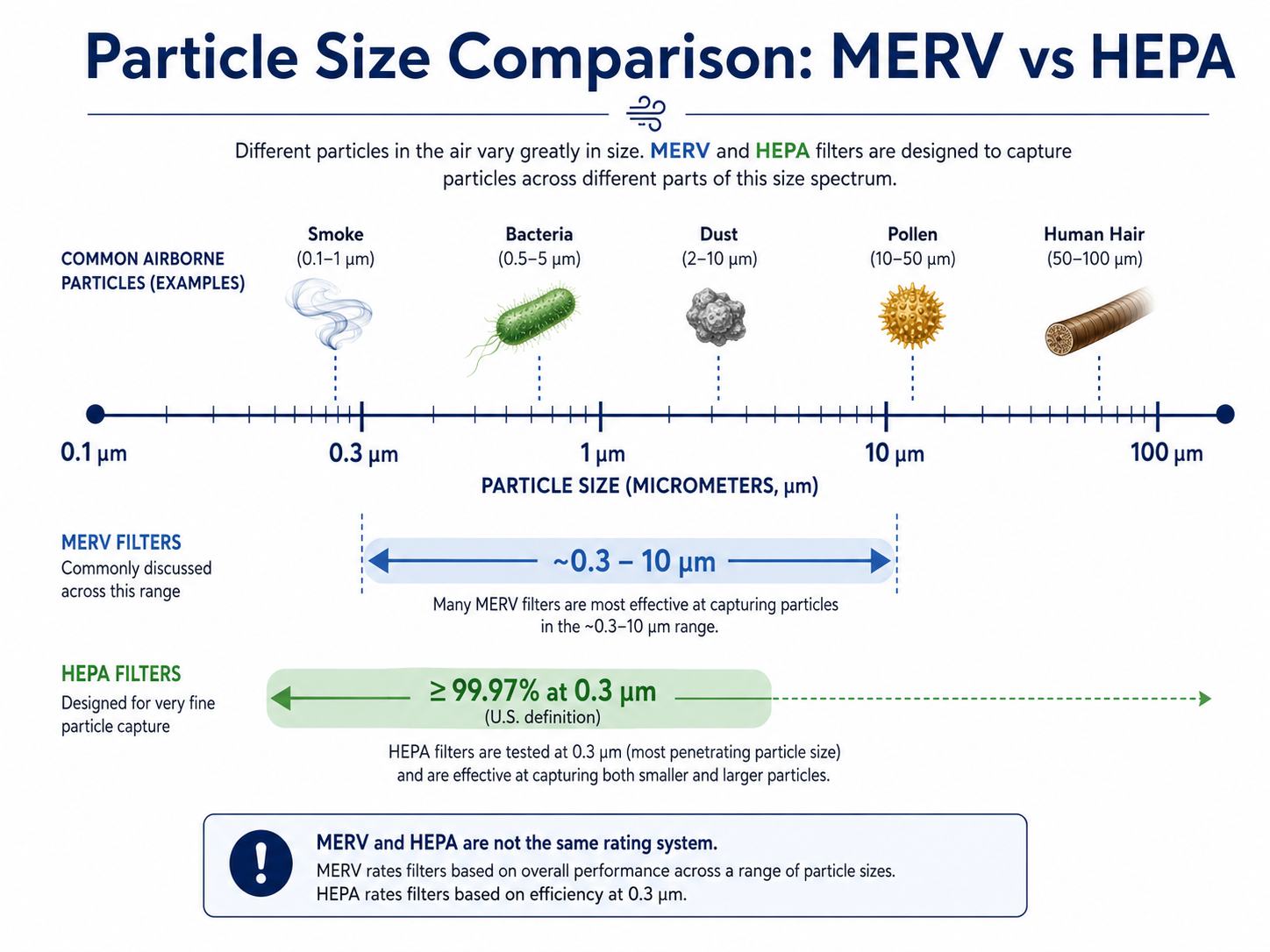
The MERV test evaluates filter performance across particle-size ranges between approximately 0.3 and 10 μm.
In general:
Lower MERV ratings focus mainly on larger particles.
Mid-range MERV filters capture progressively smaller dust and airborne particles.
Higher-rated MERV filters provide stronger fine-particle filtration.
For example, MERV 8 filters are commonly used where basic particulate filtration is required, while MERV 13–16 filters provide substantially greater fine-particle capture.
According to the U.S. EPA, the higher the MERV rating, the better the filter is at trapping specific particle sizes. However, filter efficiency must still be compatible with the airflow capability of the HVAC system.
What Is a HEPA Filter?
HEPA stands for High Efficiency Particulate Air.
A HEPA filter is a high-efficiency mechanical air filter designed to capture very fine airborne particles.
Under the commonly used U.S. definition, a HEPA filter can theoretically remove at least 99.97% of particles measuring 0.3 μm. The 0.3 μm value is important because it is often used as a challenging reference particle size for evaluating filtration performance.
Particles larger or smaller than this reference size may be captured at even higher efficiencies depending on the filter design and filtration mechanisms.
HEPA filters are therefore frequently selected when fine-particle control is substantially more demanding than ordinary HVAC filtration.
The EPA specifically treats HEPA performance separately from the MERV rating system rather than assigning HEPA filters a higher MERV number.
MERV vs HEPA Filters at a Glance
| Comparison | MERV Filter | HEPA Filter |
| Main Rating System | MERV | HEPA classification |
| Typical Range | MERV 1–16 | High-efficiency filtration |
| Main Test Focus | Particle-size efficiency across 0.3–10 μm ranges | Very high fine-particle capture |
| Typical HVAC Use | Residential, commercial and industrial ventilation | High-efficiency or critical filtration systems |
| Airflow Resistance | Depends on rating, media and filter design | Usually requires greater attention to system resistance |
| Common Structures | Pleated panel, pocket/bag, rigid box, cartridge | Mini-pleat, deep-pleat, box, V-bank and other high-efficiency designs |
| Best Selection Basis | Required efficiency + HVAC system capacity | High filtration requirement + compatible airflow/system design |
The main point is simple:
MERV and HEPA should not be treated as one continuous rating scale.
ASHRAE describes MERV as the common rating system for low- and medium-efficiency filters, while HEPA is used for higher-efficiency filtration.
How Does Particle Filtration Performance Differ?
The biggest practical difference between MERV and HEPA filters is their ability to control smaller particles.
MERV filters are evaluated over several particle-size ranges.
For example:
MERV 8
MERV 8 filters provide useful filtration for larger airborne particles and are frequently used as general HVAC filters or pre-filtration stages.
MERV 11
MERV 11 provides stronger filtration and begins to demonstrate defined performance in the 0.3–1.0 μm test range.
MERV 13
MERV 13 requires at least:
50% efficiency for 0.3–1.0 μm particles
85% efficiency for 1.0–3.0 μm particles
90% efficiency for 3.0–10.0 μm particles
MERV 14
MERV 14 increases minimum performance for the smallest tested range to at least 75%.
MERV 16
MERV 16 requires at least 95% efficiency across each of the three defined particle-size groups.
HEPA performance is still higher. Under the U.S. HEPA definition, filtration efficiency reaches at least 99.97% at 0.3 μm.
These figures make MERV 13–16 filters highly useful in many HVAC systems, but they do not make them equivalent to HEPA filters.
Is MERV 13 the Same as HEPA?
No.
MERV 13 and HEPA are not equivalent filtration grades.
This is one of the most common points of confusion when selecting HVAC air filters.
A MERV 13 filter must achieve at least 50% efficiency in the 0.3–1.0 μm particle range under the MERV rating system.
A HEPA filter, by comparison, is expected to achieve at least 99.97% efficiency at 0.3 μm under the commonly used U.S. HEPA definition.
That does not mean MERV 13 is a poor filter.
MERV 13 can offer an effective balance between:
Fine-particle capture
Airflow
System compatibility
Filter size
Initial pressure drop
Operating cost
For many commercial HVAC systems, that balance may be more important than simply choosing the highest possible filtration efficiency.
How Do MERV and HEPA Filters Affect Airflow and Pressure Drop?
Filtration efficiency should never be evaluated alone.
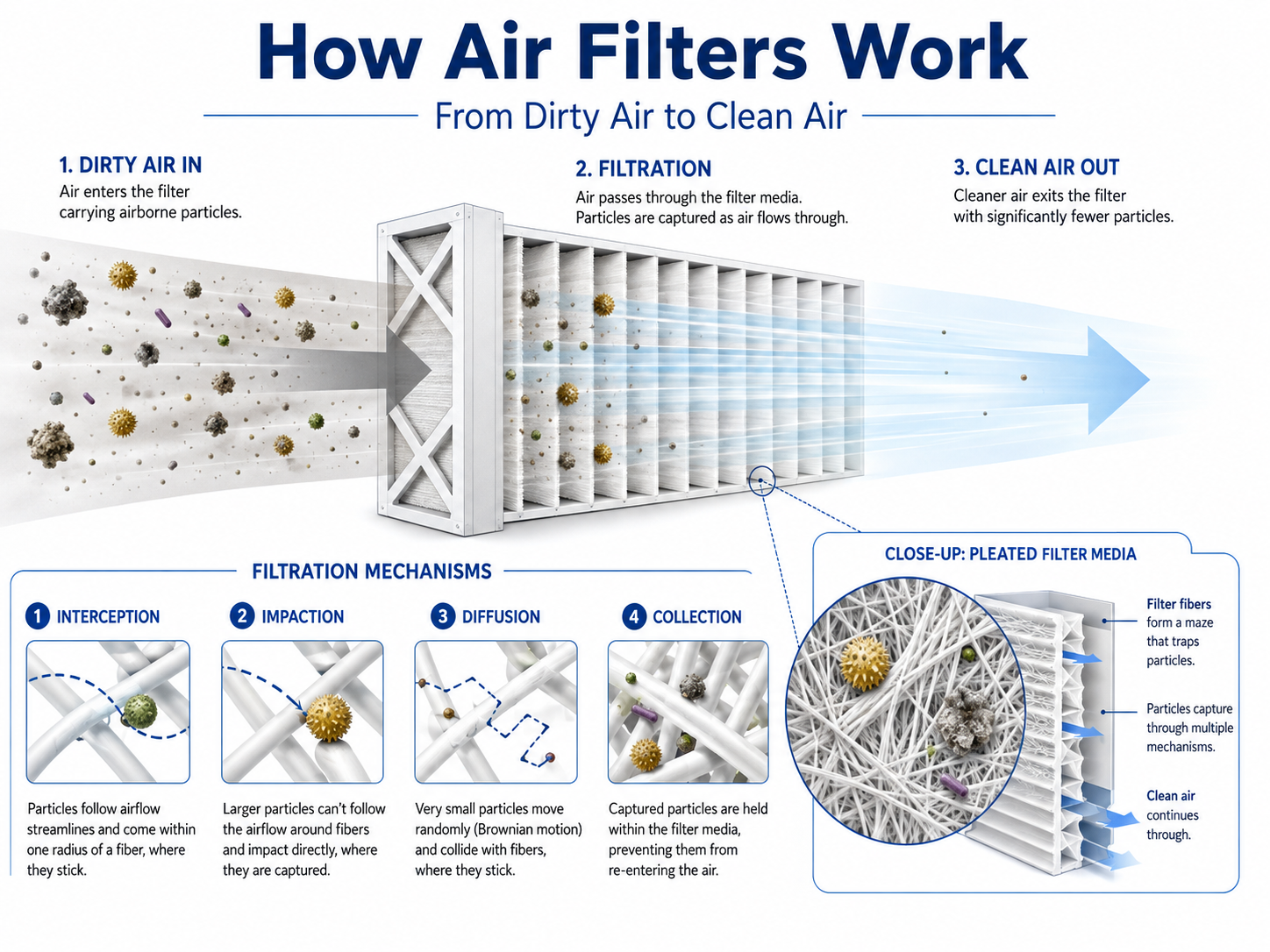
Air must physically pass through the filter media. The filter therefore creates resistance to airflow, commonly discussed as pressure drop.
Several factors influence this resistance:
Filter media type
Media density
Total media area
Pleat quantity
Pleat depth
Filter thickness
Face velocity
Dust loading
Filter structure
Airflow rate
A higher-efficiency filter may require finer or denser media, but good filter engineering can increase usable filtration area through deeper pleats, mini-pleat structures, pockets or V-bank configurations.
This is why two filters with similar filtration efficiency may not have the same pressure drop.
Why Pressure Drop Matters
If filter resistance is too high for the HVAC system, potential consequences can include:
Reduced airflow
Increased fan workload
Lower ventilation performance
Higher energy consumption
Uneven system operation
Shorter usable filter life in unsuitable operating conditions
This is also why buyers should not automatically replace a lower-rated filter with the highest MERV or HEPA filter available.
The EPA recommends choosing higher-efficiency filtration only as far as the system fan and filter slot can accommodate.
Where Are MERV Filters Commonly Used?
MERV-rated filters are suitable for a broad range of general ventilation applications.
Common applications include:
Residential HVAC Systems
Pleated MERV filters may be installed in furnaces, air-conditioning systems and central ventilation equipment.
Commercial Buildings
Offices, shopping centers, hotels, schools and other commercial buildings can use different MERV levels according to indoor air-quality requirements and HVAC system design.
Industrial Ventilation
Factories, workshops and processing facilities may use MERV-rated filters as pre-filters or intermediate filtration stages.
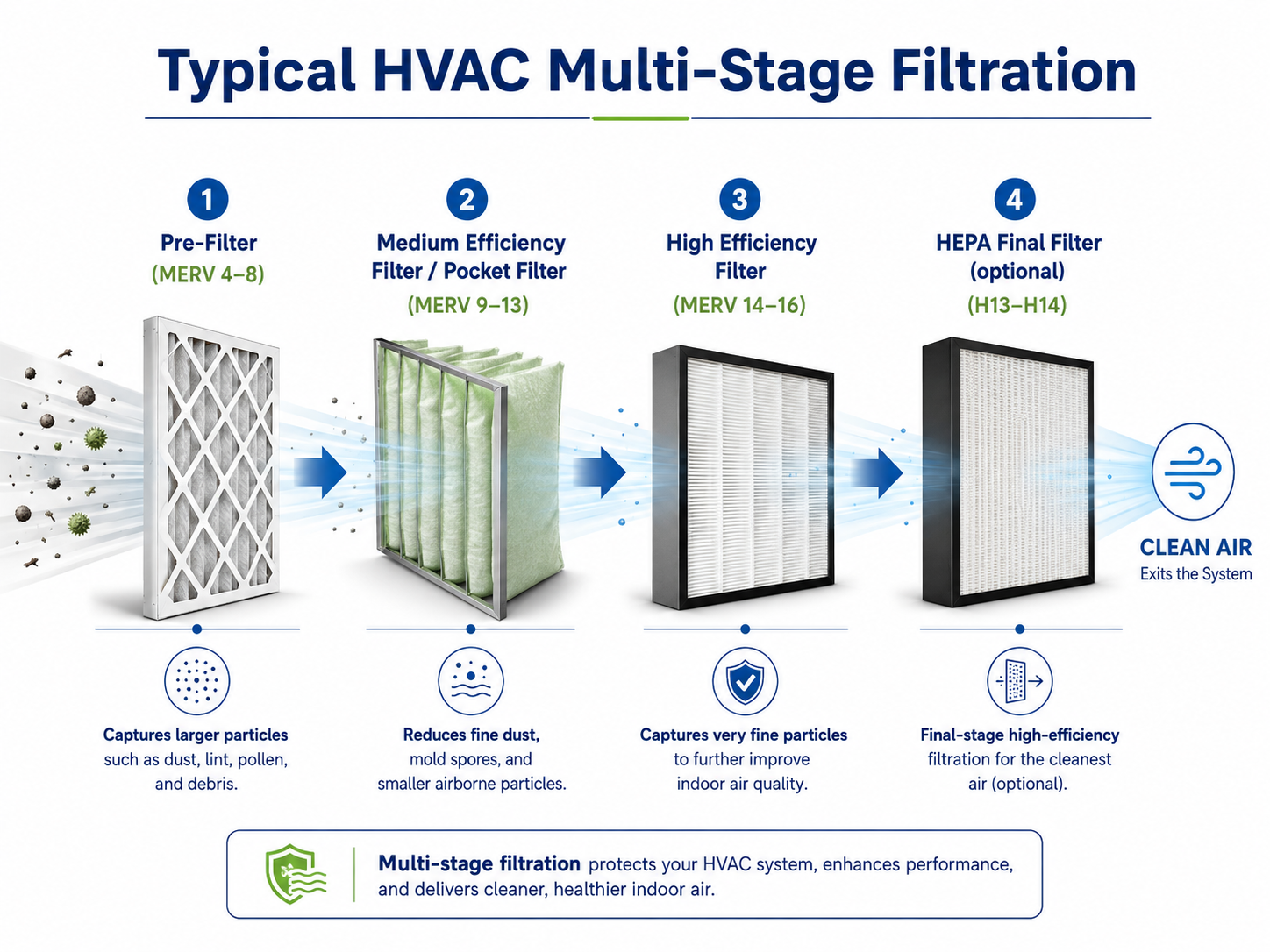
Multi-Stage HVAC Filtration
A typical system can combine:
Pre-Filter → Medium Efficiency Filter → High Efficiency Filter
This arrangement allows larger contaminants to be captured upstream before air reaches the higher-efficiency final filter.
Pocket and bag filters are frequently used as Medium Efficiency Filters in commercial and industrial HVAC installations.
Where Are HEPA Filters Commonly Used?
HEPA filters are usually selected when high fine-particle filtration efficiency is required.
Typical applications may include:
Cleanroom ventilation
Laboratory air systems
Healthcare ventilation
Pharmaceutical facilities
Precision manufacturing
Electronics production environments
High-efficiency industrial filtration
Final-stage HVAC filtration
Specialized air purification equipment
The actual filter grade and system configuration should always be selected according to the relevant project specification and applicable filtration standard.
Where H13 or H14 HEPA filters are specified, buyers should evaluate them according to the applicable HEPA classification rather than treating H13 or H14 as a MERV rating.
ASHRAE also notes that HEPA filters should be referenced through appropriate ISO or IEST classification systems rather than ASHRAE 52.2 MERV testing.
Which Filter Should You Choose?
There is no universal answer.
The correct choice depends on the air-quality target and the HVAC system in which the filter will operate.
Choose a MERV-Rated Filter When:
The application is a general ventilation or HVAC system.
The system is designed for conventional pleated, pocket or box filters.
A balance between filtration efficiency and airflow is important.
MERV 8, 11, 13, 14, 15 or 16 performance meets the project requirement.
The filter acts as a pre-filter or intermediate filtration stage.
Consider a HEPA Filter When:
Fine-particle filtration requirements are significantly higher.
The project specification specifically requires HEPA performance.
The HVAC system can accommodate the required airflow resistance.
Air cleanliness is especially important.
A final-stage high-efficiency filter is required.
Do Not Choose by Efficiency Alone
A more useful selection equation is:
Required Particle Efficiency + Airflow + Pressure Drop + Filter Size + System Capacity + Service Life = Suitable Filter
That formula gives buyers a much more realistic basis for filter selection than choosing the highest rating on a catalog page.
Blue Sky Filter HVAC Filtration Solutions
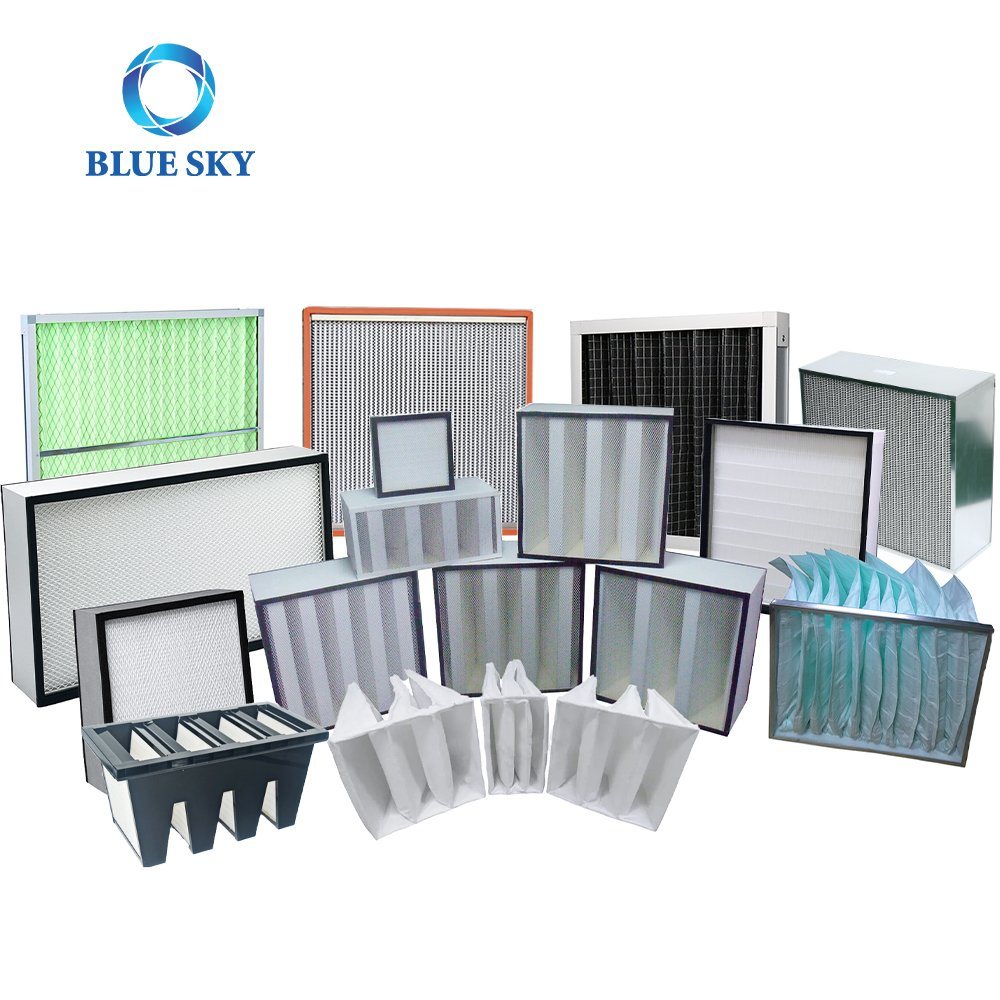
For projects requiring different filtration stages, Blue Sky Filter provides customizable HVAC air filter solutions covering general, medium and high-efficiency filtration.
Available product structures include:
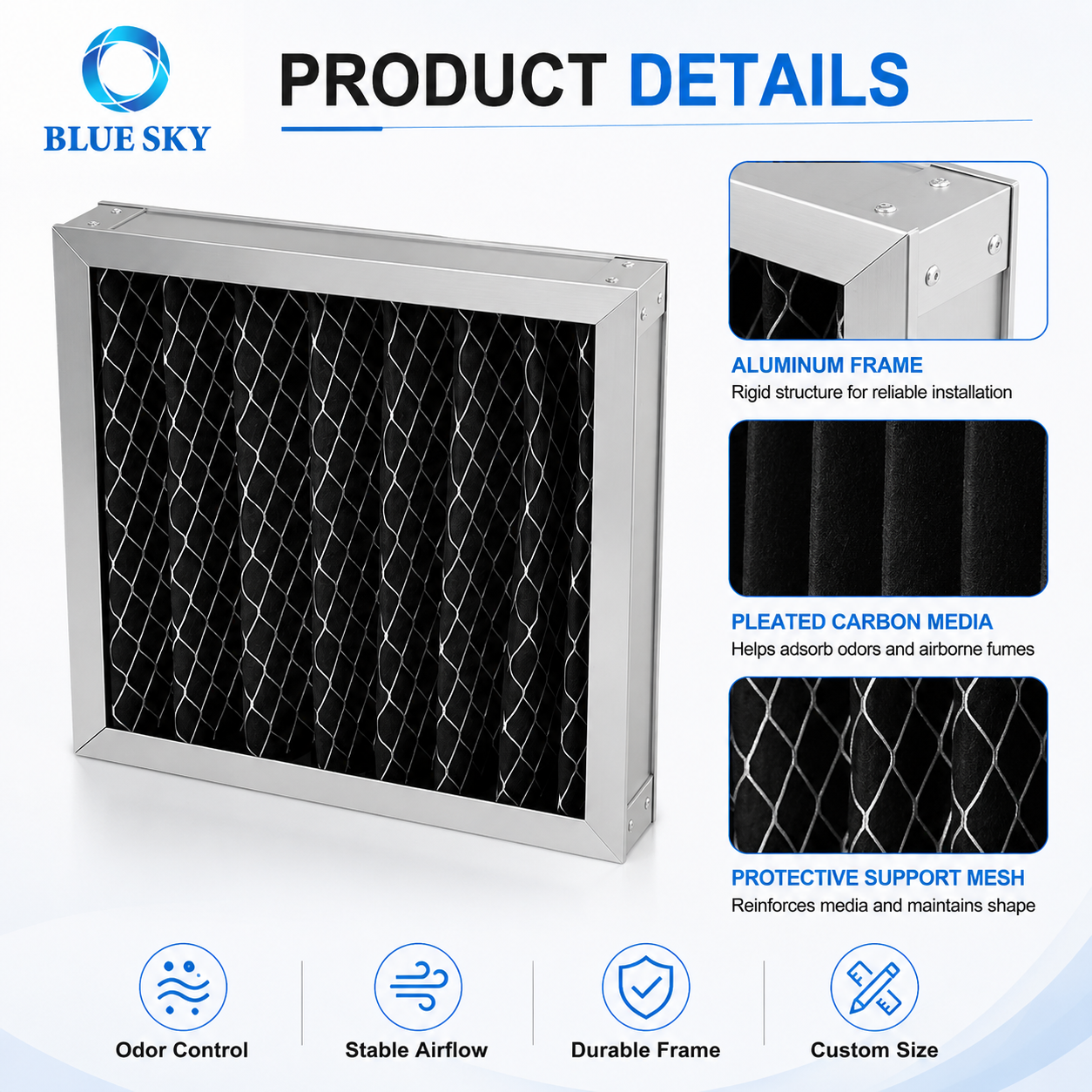
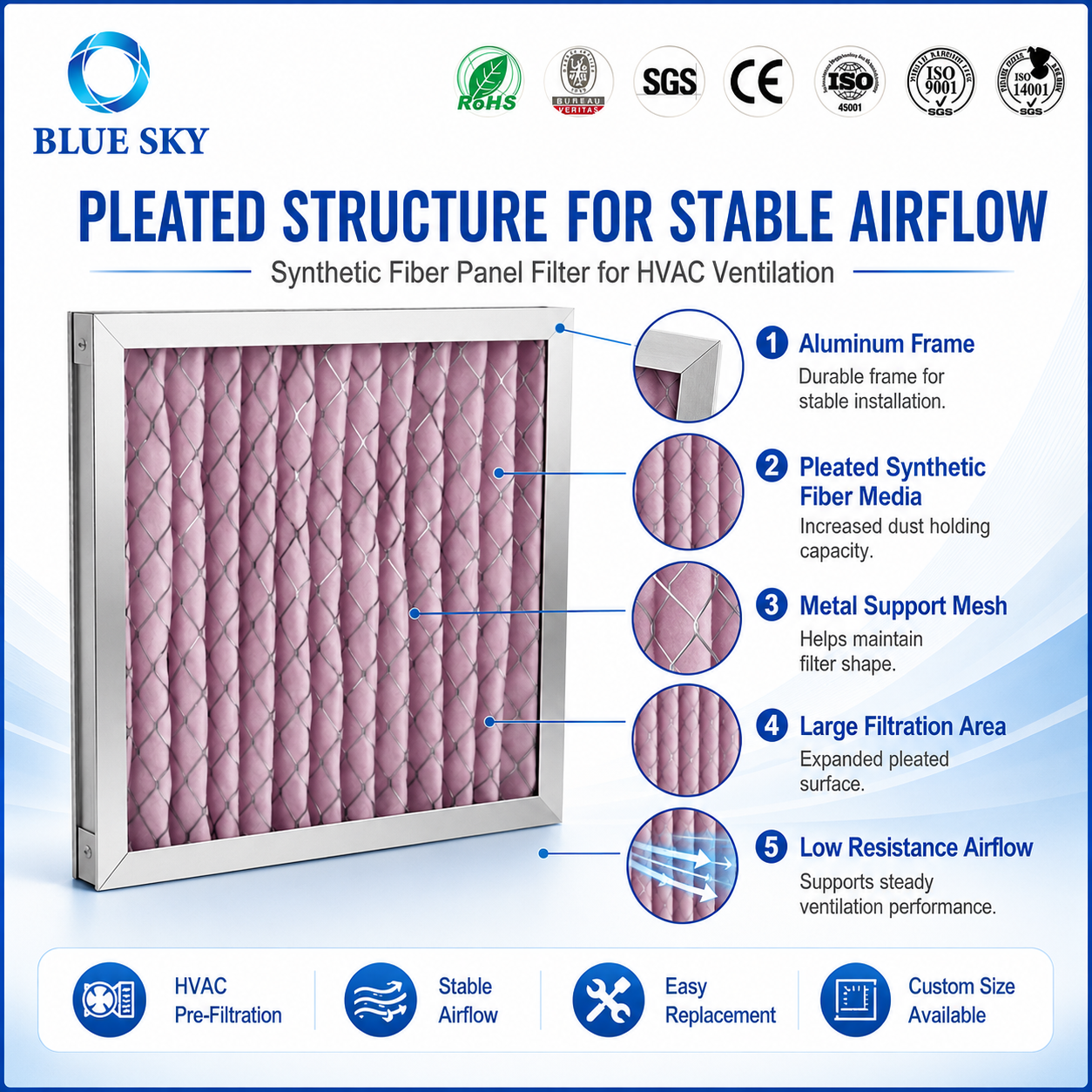
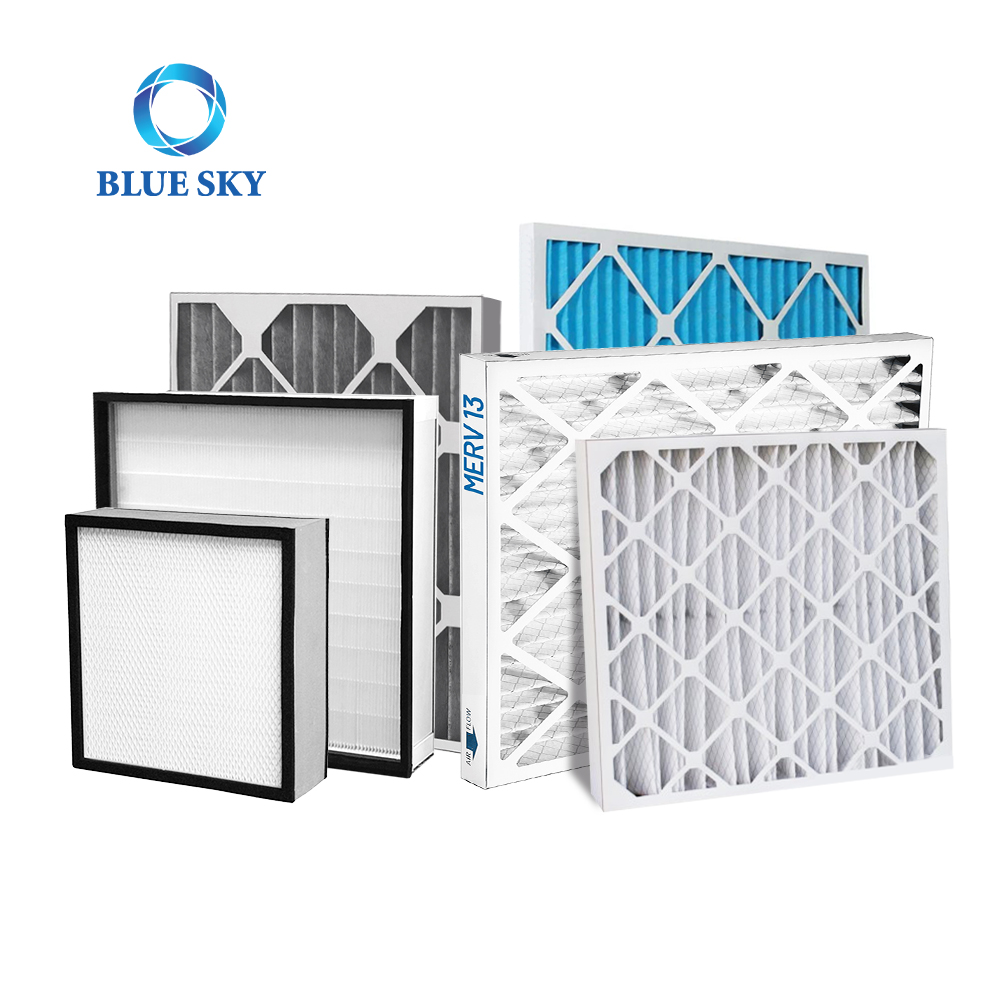
Pleated MERV HVAC Filters
Custom pleated HVAC filters are available in multiple MERV ratings for air-conditioning, furnace, commercial and industrial ventilation systems.
Different:
Sizes
Filter media
Frame configurations
Filter depths
Efficiency grades
can be developed according to project requirements.
Pocket Air Filters / Bag Filters
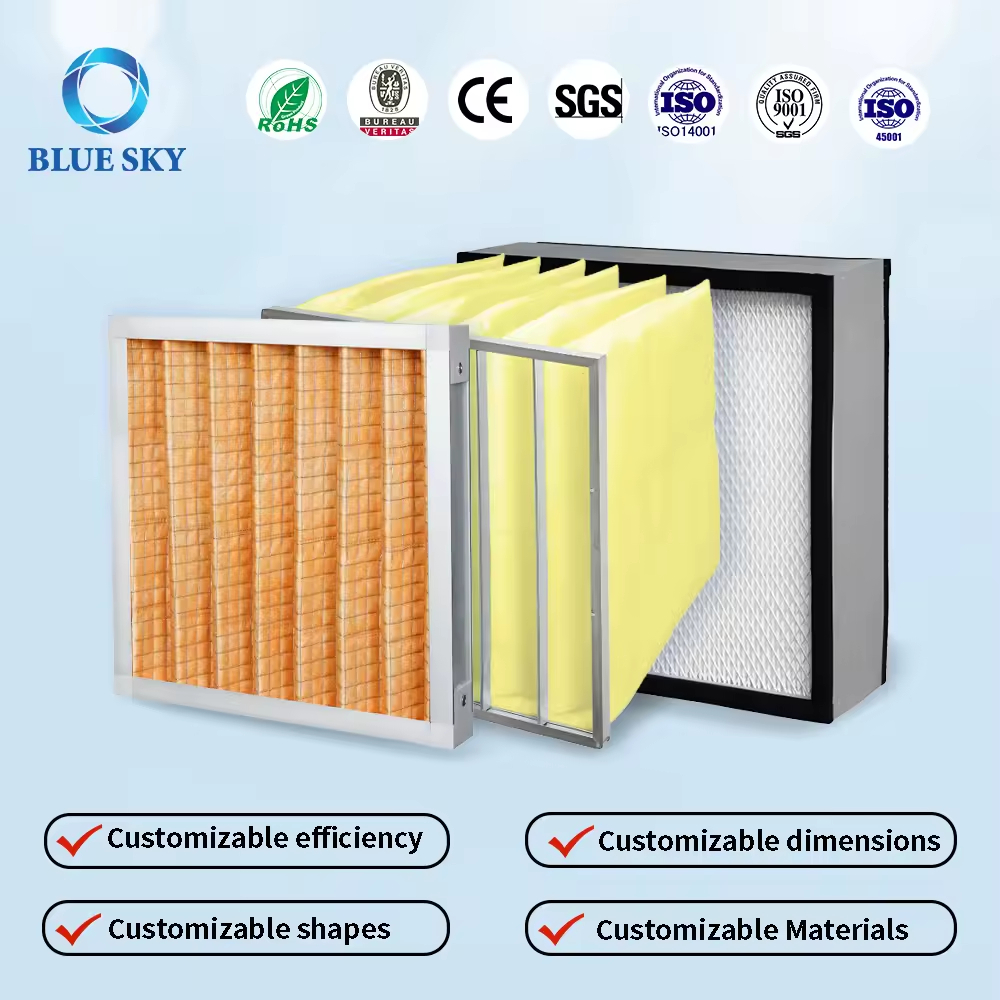
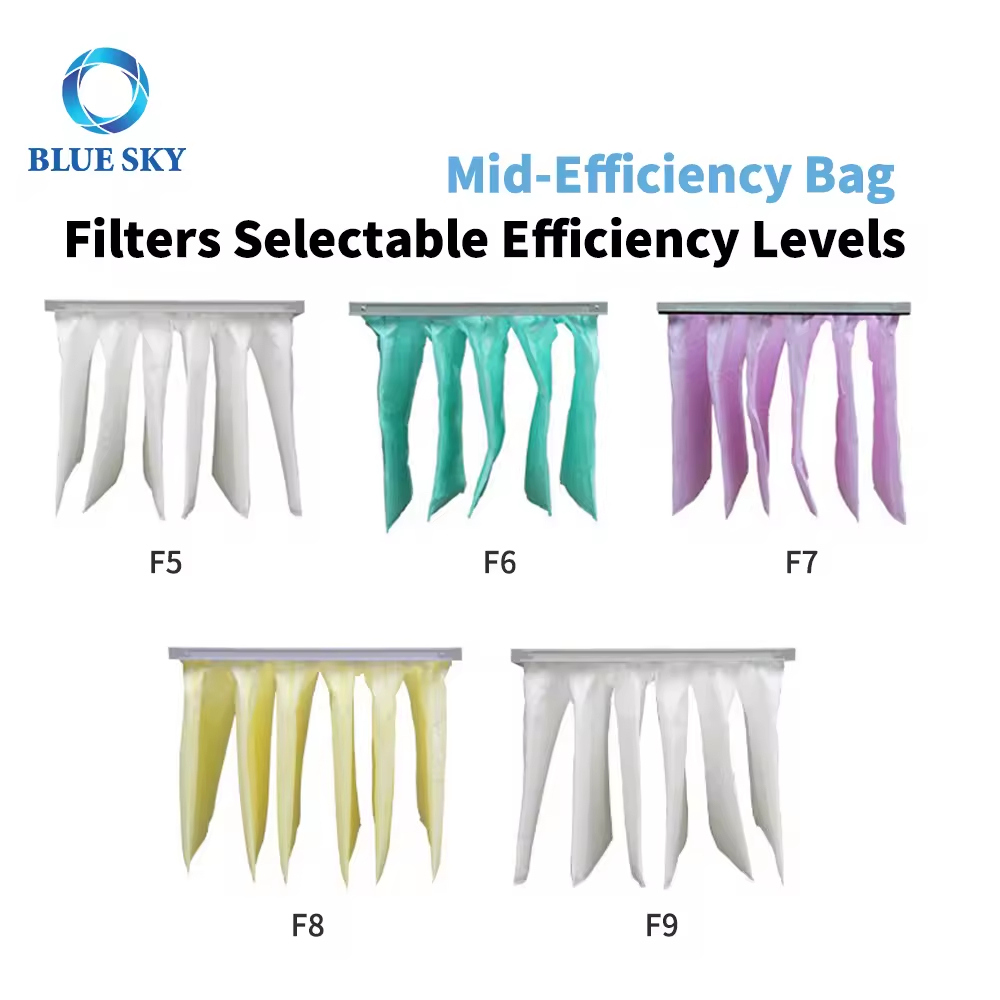
Pocket filters provide a large effective filtration area in a relatively compact frame and are commonly used as Medium Efficiency Filters in ventilation and air-conditioning systems.
Pocket quantity, pocket depth, dimensions, frame material and filtration efficiency can be customized.
H13 / H14 HEPA HVAC Filters
For applications requiring higher-efficiency final filtration, Blue Sky Filter also supplies customizable H13 and H14 HEPA filter configurations for HVAC and clean-air applications.
Available designs can include box, mini-pleat and high-air-volume structures depending on application requirements.
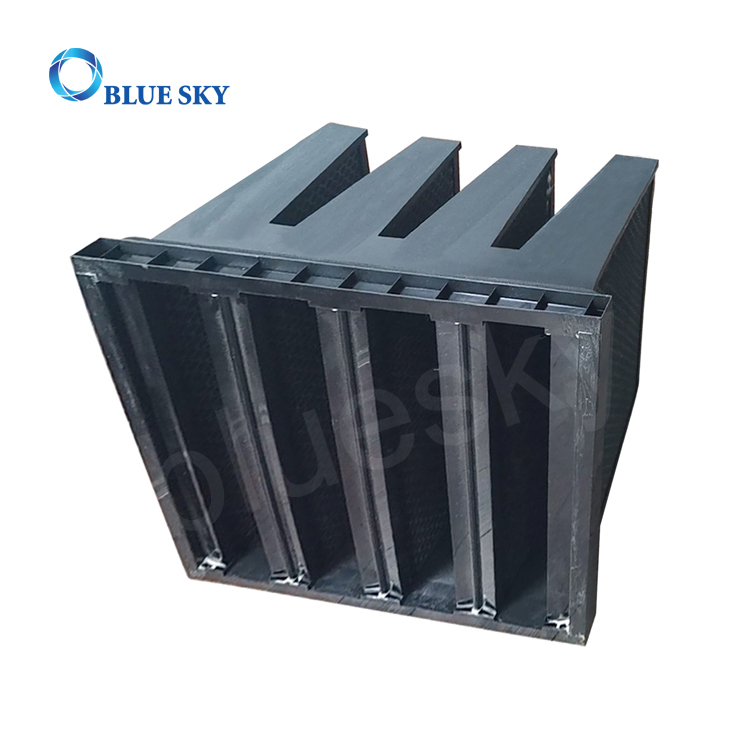
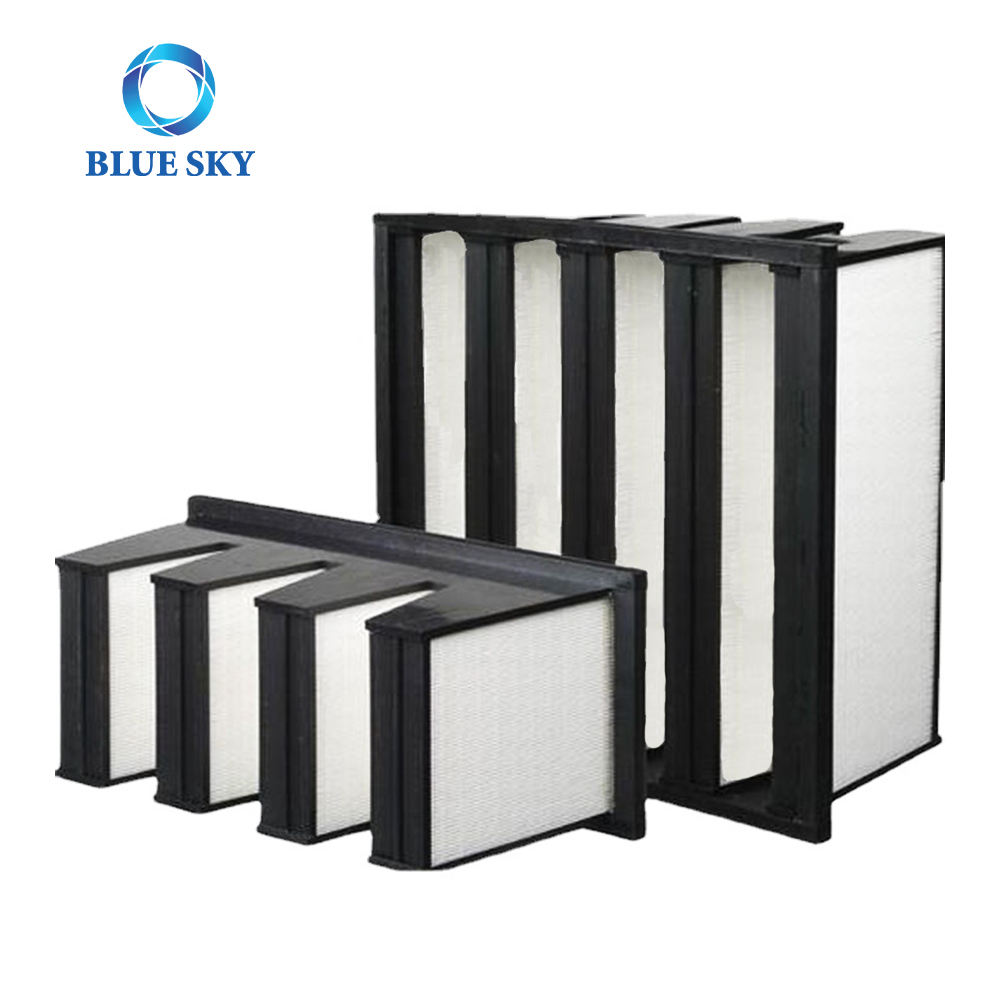
V-Bank High-Efficiency Filters
V-bank construction increases the amount of filtration media that can be installed within a compact filter depth, making this structure suitable for applications requiring high airflow and high filtration efficiency.
Blue Sky Filter's existing HVAC range includes customized MERV-rated pleated filters, pocket filters and high-efficiency H13/H14 configurations with different media, structures and dimensions.
OEM / ODM Support
For B2B projects, buyers can specify:
This allows the filter design to be matched more closely to the actual HVAC system instead of selecting only from standard retail sizes.
Common Mistakes When Comparing MERV and HEPA Filters
Mistake 1: Treating HEPA as MERV 17 or Higher
HEPA does not simply continue the MERV scale after MERV 16.
The two classifications use different performance frameworks.
Mistake 2: Assuming the Highest Efficiency Is Always Best
A filter that creates excessive resistance can be unsuitable for an HVAC system even if its particle capture efficiency is excellent.
Mistake 3: Ignoring Rated Airflow
Pressure drop should be compared at the intended operating airflow.
Mistake 4: Comparing Only the Filter Media
The complete filter matters.
Frame sealing, pleat construction, media area, filter depth and installation fit can all affect practical performance.
Mistake 5: Ignoring the Role of Pre-Filtration
A pre-filter or Medium Efficiency Filter can reduce the dust load reaching an expensive high-efficiency final filter.
A properly designed multi-stage system may therefore deliver better overall operating performance than relying on one high-efficiency filter alone.
Mistake 6: Selecting Filters Only by Nominal Size
Actual dimensions and installation tolerances should be confirmed before bulk purchasing or OEM production.
FAQ
Q1: Is a MERV 13 filter the same as a HEPA filter?
A1: No. MERV 13 and HEPA belong to different performance classifications. MERV 13 provides effective fine-particle filtration for many HVAC applications, but it does not meet the commonly used U.S. HEPA definition of at least 99.97% efficiency at 0.3 μm.
Q2: Is MERV 16 considered HEPA?
A2: No. MERV 16 is the highest rating within the standard MERV scale, but HEPA is a separate high-efficiency filtration category.
Q3: Does a higher MERV rating reduce airflow?
A3: It can increase resistance, but MERV rating alone does not determine airflow. Media area, pleat structure, filter depth, face velocity and overall design also affect pressure drop. A properly designed higher-efficiency filter can provide substantially better performance than a poorly designed filter with the same nominal rating.
Q4: Can I replace a MERV filter with a HEPA filter?
A4: Not automatically. The HVAC system must have sufficient filter space, airflow capability and fan capacity for the HEPA filter. Filter dimensions and pressure drop should be checked before making the change.
Q5: When should a pocket filter be used?
A5: Pocket or bag filters are commonly used in commercial and industrial HVAC systems where a larger filtration area and medium-to-higher filtration efficiency are required. They can also serve as an intermediate stage before a higher-efficiency final filter.
Q6: What information should I provide when ordering a custom HVAC filter?
A6: Buyers should ideally provide dimensions, required efficiency, rated airflow, acceptable pressure drop, filter depth, frame material, media requirements, application environment and expected order quantity. Existing samples or technical drawings can also help confirm the correct structure.
Q7: Are MERV ratings and H13/H14 grades directly interchangeable?
A7: No. MERV and HEPA classifications are based on different testing and classification systems. Buyers should follow the filtration standard specified for the project rather than using a simple one-to-one conversion.
Q8: Which is better for a commercial HVAC system, MERV or HEPA?
A8: It depends on the required air cleanliness and the capability of the HVAC system. Many commercial ventilation systems can use MERV-rated filters effectively, while HEPA filtration is generally selected for projects requiring substantially higher particle removal performance.
Conclusion
The difference between MERV and HEPA filters is not simply a question of which number is higher.
MERV filters are designed to provide defined particle filtration performance for general ventilation and HVAC applications, while HEPA filters address much higher-efficiency filtration requirements through a separate classification system.
For most projects, the best filter is the one that balances:
Filtration Efficiency + Airflow + Pressure Drop + System Compatibility + Service Life
Residential and commercial HVAC systems may benefit from appropriately selected MERV filters, while cleanrooms, laboratories, healthcare facilities and other demanding environments may require HEPA filtration.
For B2B buyers, system designers and distributors, evaluating the complete filter structure is therefore more useful than comparing efficiency labels alone.
Blue Sky Filter provides customized HVAC filtration solutions including MERV-rated pleated filters, Medium Efficiency Pocket Filters, H13/H14 HEPA filters and high-air-volume filter structures for different commercial and industrial applications.
For custom dimensions, efficiency grades, filter media, frame structures, samples or OEM/ODM requirements, contact Blue Sky Filter with your filtration specifications.
Sources & Standards
ASHRAE Standard 52.2
Method of Testing General Ventilation Air-Cleaning Devices for Removal Efficiency by Particle Size. ASHRAE currently lists Standard 52.2-2025 as the current edition.
U.S. Environmental Protection Agency – What Is a MERV Rating?
EPA explains the MERV particle-size ranges, MERV 1–16 performance levels and the distinction between MERV and HEPA filtration.
U.S. Environmental Protection Agency – What Is a HEPA Filter?
EPA defines HEPA as a pleated mechanical air filter capable of theoretically removing at least 99.97% of particles at 0.3 μm.
If you want to see our updates in real time on social media, you can follow the following accounts.
LinkedIn: linkedin.com/company/blueskyfilter
Twitter: twitter.com/blueskyfilter
Facebook: www.facebook.com/blueskyfilter.manufacturer/
Youtube: www.youtube.com/@blueskyfilter
Instagram: https://www.instagram.com/nanjingblueskyfilters/