Stainless Steel Hose Clamps for Air Filters: Selection Guide
To choose a stainless steel hose clamp for air filters in salt-exposed environments, match the clamp's adjustment range and band width to the assembled filter flange, and verify the corrosion resistance of the band, housing, and screw. Grade 316 stainless steel generally offers better chloride corrosion resistance than 304, but the final choice depends on installation conditions, exposure severity, and required service life.
For automotive air filter distributors, motorcycle filter suppliers, and OEM buyers, hose clamp selection involves more than choosing a stainless steel grade. A suitable clamp must provide secure fastening without damaging the filter flange, while its components must meet the material requirements of the intended application.
1. What Should Buyers Check Before Selecting a Stainless Steel Hose Clamp?
Before selecting a stainless steel hose clamp for an air filter, buyers should verify the assembled flange diameter, clamp adjustment range, band width, installation clearance, and material specifications. These factors determine whether the clamp is suitable for the connection and operating environment.
The following checklist summarizes the main selection requirements.
| Selection Factor | What to Check | Why It Matters |
| Flange diameter | Actual outer diameter at the clamp position | Determines the required clamp size |
| Clamp adjustment range | Minimum and maximum applicable diameter | Ensures the clamp can fit and be adjusted |
| Band width | Available fastening surface on the flange | Helps prevent unsuitable pressure distribution |
| Installation clearance | Space around the filter connection | Allows correct clamp positioning and tightening |
| Stainless steel grade | 304, 316, or other specified material | Helps evaluate corrosion resistance |
| Component materials | Band, housing, and screw | Confirms the complete assembly meets material requirements |
| Exposure conditions | Road salt, coastal air, moisture, or other corrosive conditions | Supports appropriate material selection |
Buyer consideration: A clamp should be evaluated as part of the complete filter connection, rather than selected by nominal diameter or stainless steel grade alone.
2. How Do You Match a Hose Clamp to an Air Filter Flange?
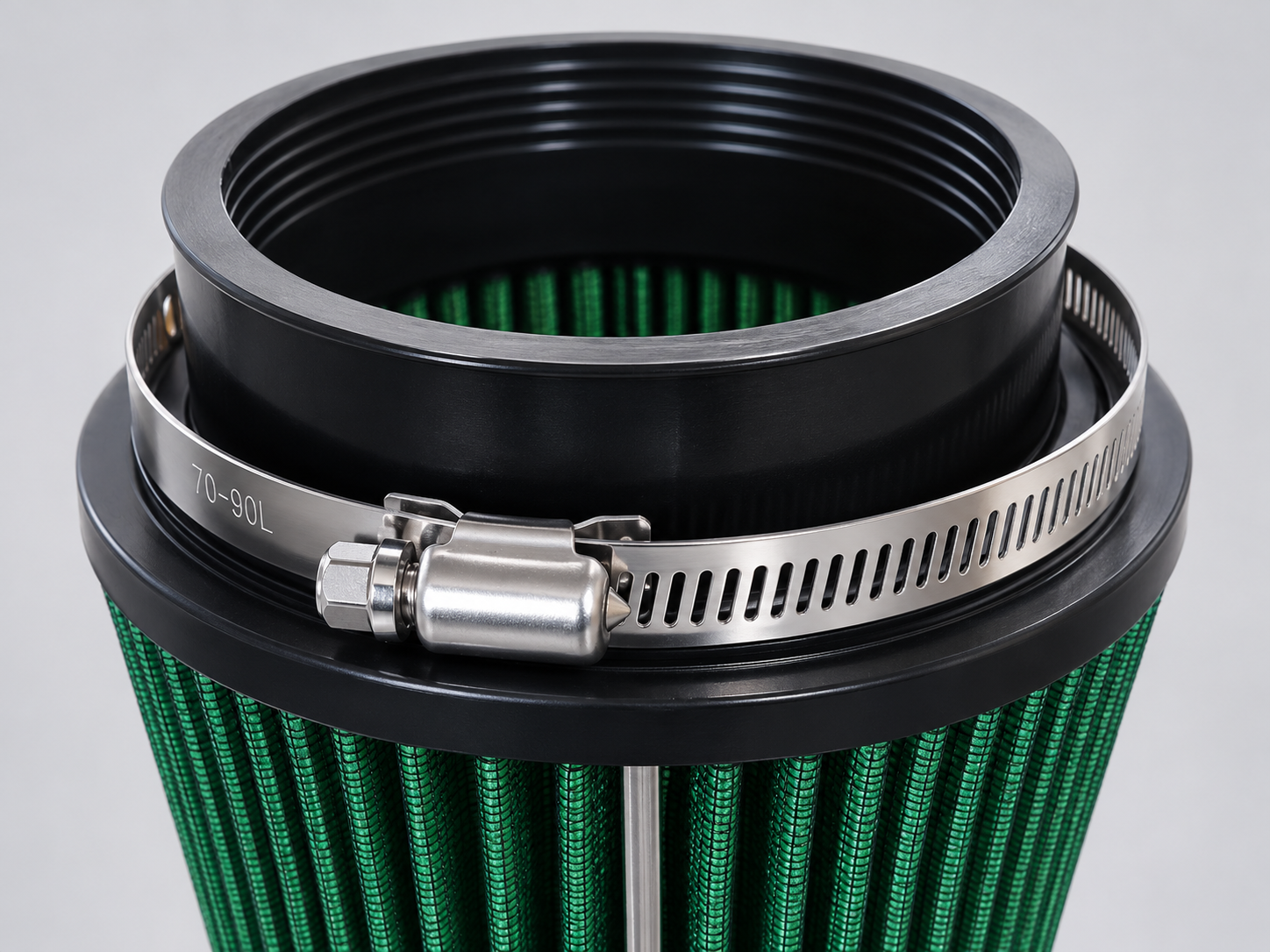
A hose clamp should match the assembled outer diameter of the filter connection, fit within the available fastening area, and allow sufficient clearance for installation and tightening.
Three measurements are particularly important.
2.1 Measure the Assembled Flange Diameter
The filter flange outer diameter is a starting point for clamp selection.
However, if a flexible rubber or silicone flange is fitted over a rigid intake pipe, the assembled connection diameter may differ from the flange's original dimensions.
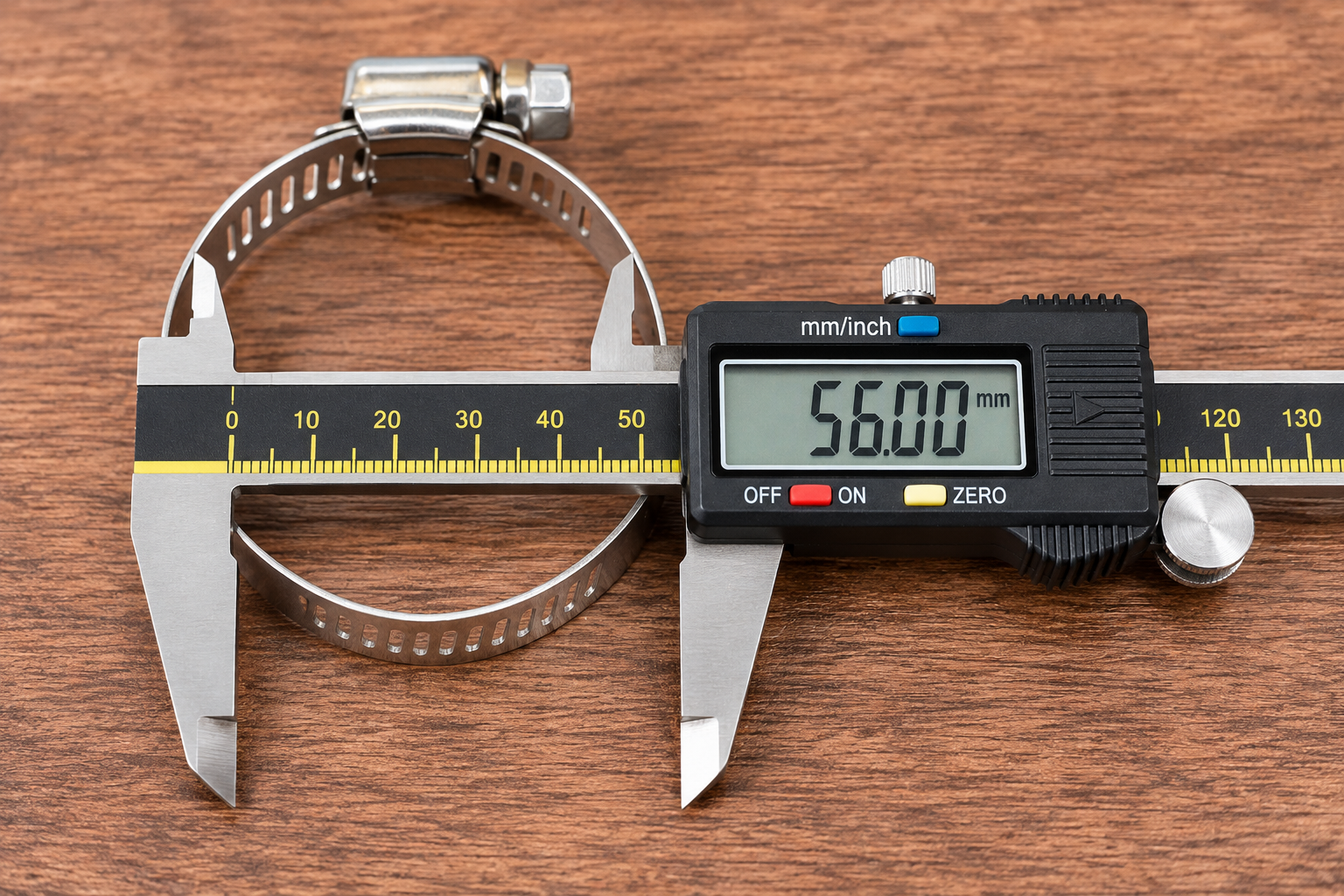
Buyers should therefore confirm the actual diameter at the intended clamp position.
For customized filter assemblies, a flange drawing or a photo showing the connection structure can help the manufacturer evaluate compatibility.
2.2 Verify the Clamp Adjustment Range and Band Width
Most hose clamps are designed to operate within a specified diameter range.
The selected clamp should accommodate the assembled connection diameter while allowing sufficient adjustment for proper installation.
Band width is also important.
A clamp that is too wide for the available fastening area may extend beyond the intended clamping surface. Excessive tightening or unsuitable band dimensions may also deform a flexible flange.
The appropriate tightening method should be determined according to the clamp design and flange material.
2.3 Confirm Installation Clearance
The clamp must be accessible during installation.
Buyers should consider nearby engine components, the location of the tightening screw, and the available space around the air intake connection.
For applications with limited clearance, the clamp design and tightening arrangement should be reviewed before ordering.
3. Is 304 or 316 Stainless Steel Better for Salt-Exposed Air Filter Applications?
316 stainless steel generally offers better resistance to chloride-related localized corrosion than 304 stainless steel. However, neither grade is completely immune to corrosion, and the appropriate choice depends on the actual exposure conditions and required performance.
3.1 304 Stainless Steel
304 stainless steel provides good general corrosion resistance and is widely used in industrial applications.
It may be suitable for air filter installations where environmental exposure is compatible with its corrosion resistance.
However, prolonged or aggressive chloride exposure can increase the risk of localized corrosion, including pitting or crevice corrosion.
Buyers should therefore evaluate the actual operating environment before selecting 304 stainless steel for salt-exposed applications.
3.2 316 Stainless Steel
316 stainless steel contains molybdenum, which generally improves resistance to localized chloride-related corrosion compared with 304.
This makes 316 worth considering for applications involving coastal environments, road salt, or other demanding corrosion conditions.
However, the use of 316 stainless steel does not guarantee that the clamp will remain corrosion-free under all conditions.
Component geometry, surface condition, exposure severity, and the materials used throughout the complete clamp assembly can also affect performance.
3.3 Comparison of 304 and 316 Stainless Steel
| Factor | 304 Stainless Steel | 316 Stainless Steel |
| General corrosion resistance | Good | Good |
| Chloride-related corrosion resistance | Lower than 316 under comparable conditions | Generally higher than 304 |
| Molybdenum | Not a principal intentional alloying addition | Contains molybdenum |
| Potential application | General applications with suitable exposure conditions | Applications requiring increased chloride corrosion resistance |
| Main buyer consideration | Verify actual environmental exposure | Confirm the grade and complete assembly specifications |
Selection recommendation: Buyers should specify the required material grade according to the intended operating environment rather than assuming that all stainless steel clamps provide the same corrosion resistance.
4. Does a Stainless Steel Hose Clamp Always Have a Stainless Steel Screw?
No. A hose clamp described as stainless steel does not necessarily contain stainless steel in every component.
Some clamp designs use a stainless steel band or housing together with a screw made from a different material.
For applications involving salt exposure, the material specifications of the complete assembly should be confirmed.
The main components to check include:
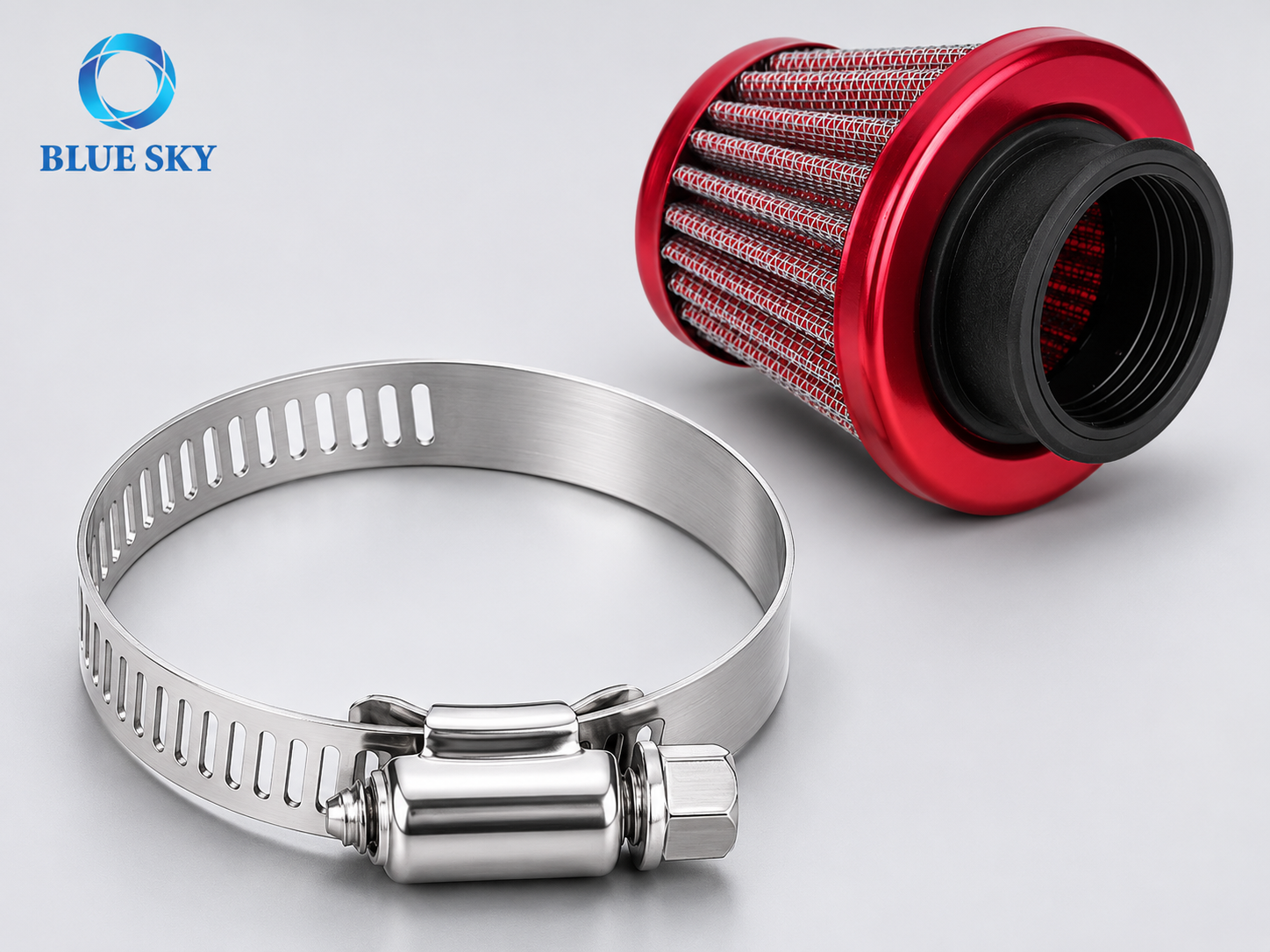
Clamp band: The metal strip that surrounds the filter flange or connecting hose.
Clamp housing: The structure that supports the tightening mechanism.
Clamp screw: The threaded component used to tighten the clamp.
For buyers requesting an all-stainless-steel clamp, the required material specifications should cover all relevant components, including the screw.
It is also important to distinguish between a stainless steel component and a specific stainless steel grade. A clamp described as stainless steel should not automatically be assumed to use 304 or 316 material throughout.
Buyer consideration: Ask the supplier to confirm the band, housing, and screw materials separately when corrosion resistance is an important requirement.
5. What Does Salt Spray Testing Tell Buyers About Hose Clamp Corrosion Resistance?
Salt spray testing evaluates corrosion behavior under defined laboratory conditions. It can support material and component assessment, but the test duration does not directly predict how long a hose clamp will last in an actual vehicle application.
Commonly referenced test methods include ASTM B117 and ISO 9227.
When specifying salt spray testing, buyers should clarify:
For example, specifying a test duration without defining acceptance criteria may not provide enough information to determine whether the results meet the application's requirements.
The operating environment should also be considered.
Exposure to road salt, coastal air, moisture, temperature changes, and other environmental conditions can differ significantly from laboratory test conditions.
Important: A salt spray test result should not be converted directly into a guaranteed number of years of service life.
If corrosion testing is required for a custom filter and clamp assembly, the testing requirements should be agreed upon before production.

6. What Information Is Needed for a Custom Air Filter and Hose Clamp Assembly?
Buyers requesting a custom air filter with a matching stainless steel hose clamp should provide the flange specifications, installation requirements, material grade, corrosion conditions, and estimated order quantity.
Complete technical information helps the manufacturer evaluate compatibility and supply feasibility before sampling or quotation.
| Required Information | Purpose |
| Flange drawing or dimensions | Evaluate clamp fit |
| Assembled connection diameter | Determine the appropriate clamp adjustment range |
| Clamp band width requirements | Confirm the available fastening area |
| Installation clearance | Check positioning and tightening space |
| Stainless steel grade | Define material requirements |
| Corrosion exposure conditions | Evaluate suitability for the intended environment |
| Vehicle model or application | Understand installation requirements |
| Estimated order quantity | Support feasibility and quotation evaluation |
Product drawings, samples, or photos of the existing connection may also help clarify the requirements.
For applications requiring increased corrosion resistance, buyers should specify whether the material requirement applies to the clamp band, housing, screw, or the entire assembly.
7. Frequently Asked Questions
Q1: Can one stainless steel hose clamp fit different air filter flange sizes?
Yes, provided the assembled connection diameters fall within the clamp's specified adjustment range. Band width and available installation clearance must also be checked.
Q2: Is a 316 stainless steel hose clamp always necessary for salt-exposed vehicles?
Not necessarily. Although 316 generally provides better chloride corrosion resistance than 304, the material choice should depend on actual exposure conditions and performance requirements.
Q3: Does a stainless steel hose clamp always include a stainless steel screw?
No. Some clamps use screws made from materials different from those used in the band or housing. The material of each component should be confirmed separately.
Q4: Can a clamp be selected based only on the filter flange diameter?
No. Buyers should also verify the assembled diameter, adjustment range, band width, flange construction, and installation clearance.
Q5: Does passing a salt spray test guarantee corrosion resistance during actual use?
No. Salt spray testing evaluates performance under controlled conditions and does not directly establish actual service life.
Q6: Can Nanjing Blue Sky supply air filters with stainless steel hose clamps?
Nanjing Blue Sky can review requirements for filters with matching stainless steel hose clamps and evaluate supply feasibility based on flange dimensions, installation specifications, required materials, and corrosion resistance requirements.
8. Conclusion: Select the Hose Clamp and Filter Flange as One Assembly
Choosing a stainless steel hose clamp for an air filter requires careful consideration of both mechanical fit and corrosion resistance.
The assembled flange diameter, clamp adjustment range, band width, installation clearance, and material specifications all influence the final selection.
For applications involving salt exposure, buyers should compare 304 and 316 stainless steel according to the actual operating conditions and confirm the materials of all relevant clamp components.
Clear specifications can help reduce compatibility issues and improve communication before sampling or production.
Need a Custom Air Filter and Stainless Steel Hose Clamp Solution?
Nanjing Blue Sky Filter can review requests for custom air filters supplied with matching stainless steel hose clamps.
To discuss your requirements, please send:
Filter flange drawing or dimensions
Vehicle model or intended application
Required clamp size and stainless steel grade
Corrosion exposure or salt spray testing requirements
Estimated order quantity
Our team can review your specifications and evaluate the feasibility of a suitable filter and hose clamp configuration before sampling or quotation.
Please feel free to send your inquiry to sales@bluesky-filter.com.
If you want to see our updates in real time on social media, you can follow the following accounts.
LinkedIn: linkedin.com/company/blueskyfilter
Twitter: twitter.com/blueskyfilter
Facebook: www.facebook.com/blueskyfilter.manufacturer/
Youtube: www.youtube.com/@blueskyfilter
Instagram: https://www.instagram.com/nanjingblueskyfilters/