Yes. Nanjing Blue Sky confirms that its 0.1 micron PP pleated filter cartridge can be considered for systems operating at 0.5 MPa (5 bar). However, operating pressure is not the same as differential pressure. Before installation, buyers must verify the cartridge's maximum allowable differential pressure, housing pressure rating, fluid compatibility, and operating temperature to determine whether the complete filtration system is suitable.
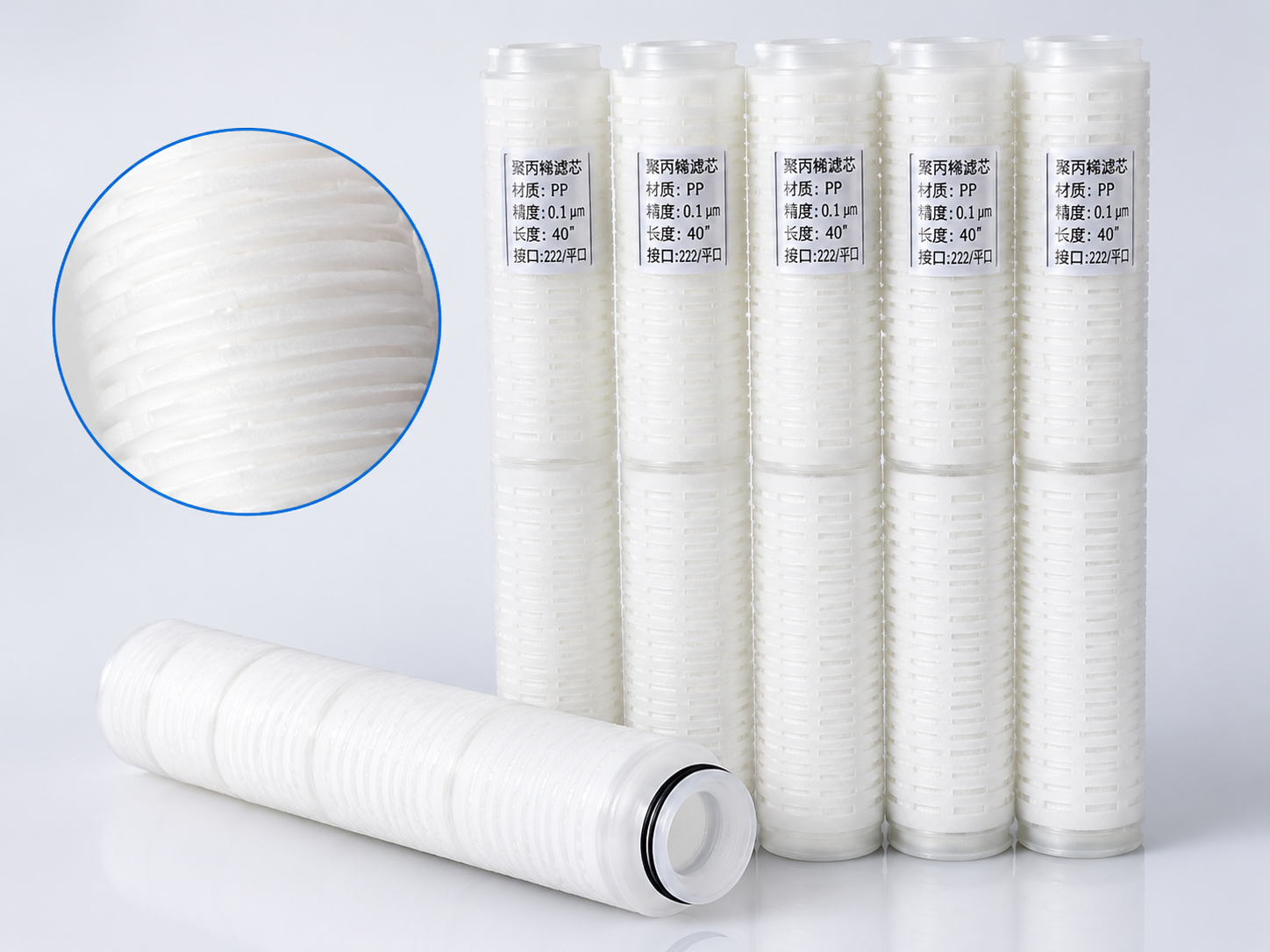
For industrial filtration buyers, distributors, and equipment manufacturers, pressure compatibility is an important part of selecting a replacement filter cartridge.
A cartridge may be suitable for the system's operating pressure while still requiring separate verification of the pressure difference across the filter media.
The following guide explains which specifications matter, why differential pressure must be checked, and how to evaluate samples before placing a bulk order.
1. What Are the Key Specifications of This 0.1 Micron PP Pleated Filter Cartridge?
The key specifications are polypropylene filter material, a 0.1 micron filtration rating, and a stated operating pressure of 0.5 MPa. Additional mechanical and operating limits must be confirmed for the exact cartridge configuration.
| Parameter | Specification |
| Filter type | PP Pleated Filter Cartridge |
| Filter material | Polypropylene (PP) |
| Filtration rating | 0.1 micron |
| Stated operating pressure | 0.5 MPa (5 bar) |
| Maximum allowable differential pressure | To be confirmed for the selected configuration |
A 0.1 micron filtration rating describes particle retention characteristics, not the mechanical pressure resistance of the cartridge.
Buyers should therefore evaluate filtration performance and pressure limitations as separate specifications.
2. What Is the Difference Between Operating Pressure and Differential Pressure?
Operating pressure describes the pressure within the filtration system, while differential pressure (ΔP) is the pressure difference between the inlet and outlet of the filter. These values serve different purposes and should not be treated as interchangeable.
Differential pressure is calculated as:
ΔP = Inlet Pressure − Outlet Pressure
For example, consider a filtration system with the following hypothetical readings:
| Measurement | Example Value |
| Filter inlet pressure | 0.50 MPa |
| Filter outlet pressure | 0.45 MPa |
| Differential pressure | 0.05 MPa |
In this example, the inlet pressure is 0.50 MPa, but the pressure difference across the filtration stage is only 0.05 MPa.
These values illustrate why a cartridge intended for a 0.5 MPa system does not necessarily need to withstand a 0.5 MPa differential pressure during normal filtration.
However, the maximum differential pressure may rise if the filter becomes blocked or the system experiences an abnormal operating condition.
Buyer consideration: Always request the maximum allowable differential pressure for the exact cartridge design rather than assuming it equals the system operating pressure.
3. Why Does Differential Pressure Matter for Filter Cartridge Safety?
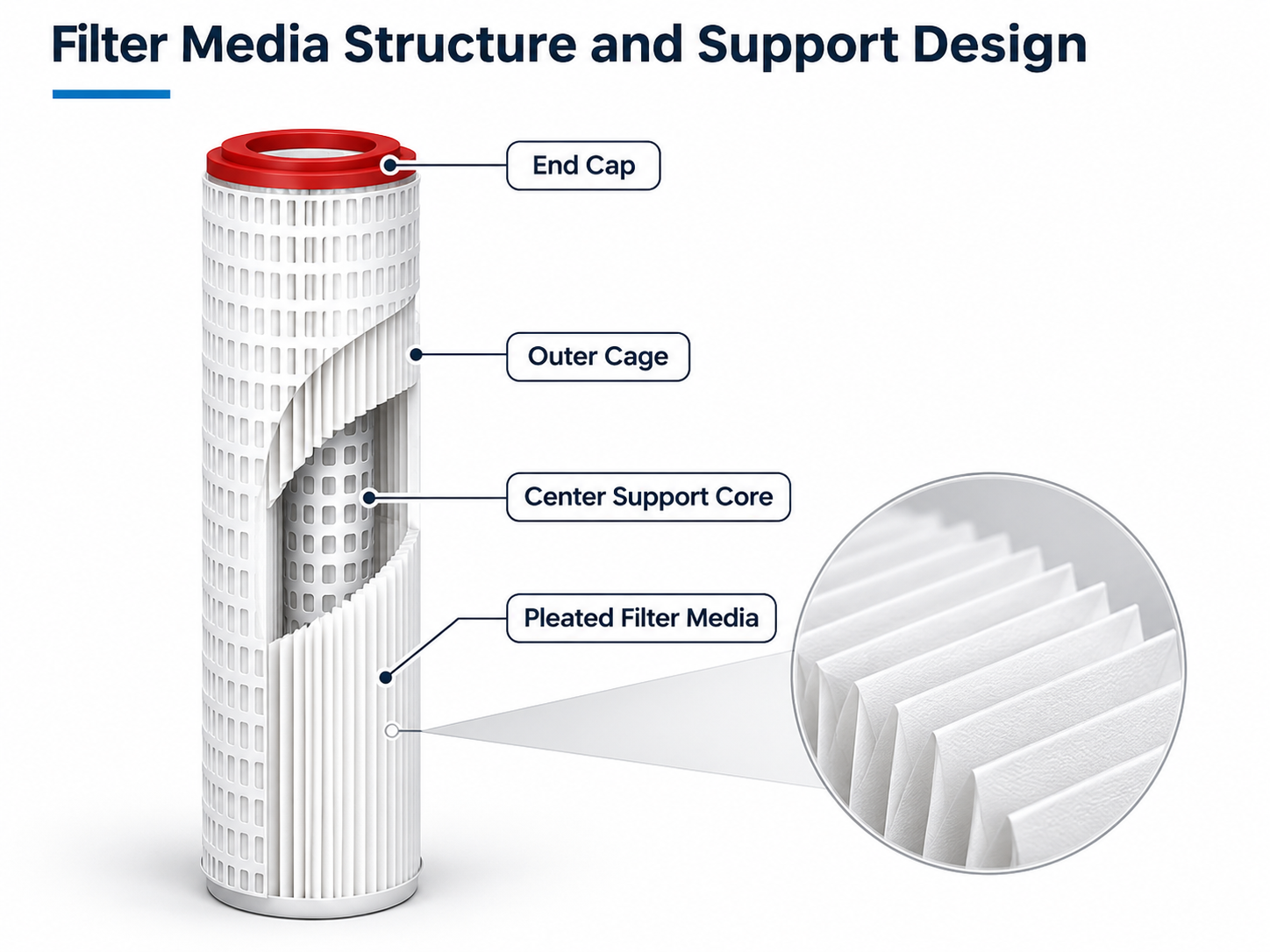
Differential pressure affects the mechanical load on the filter cartridge. If the pressure difference exceeds the cartridge's allowable limit, the media, core, or supporting structure may become damaged.
During filtration, captured particles can gradually increase flow resistance.
If the system maintains a relatively constant flow rate, this additional resistance will typically increase differential pressure.
Several conditions may contribute to excessive pressure loading:
Particle accumulation and filter blockage
High flow rates
Increased fluid viscosity
Sudden pressure changes
Incorrect cartridge installation
Incompatible or inadequate internal support
Depending on the cartridge construction and flow direction, excessive differential pressure may cause deformation, collapse, or other structural damage.
The maximum permissible differential pressure depends on the specific cartridge design and operating conditions, including temperature.
A 0.5 MPa operating pressure statement should never be used as a substitute for the cartridge's maximum differential pressure specification.
Buyers should also confirm the filter housing's pressure rating and whether the system experiences pressure surges or repeated start-stop cycles.
4. What Other Factors Should Buyers Check Before Using the Cartridge at 0.5 MPa?
In addition to pressure ratings, buyers should verify fluid compatibility, operating temperature, flow conditions, cartridge dimensions, and sealing configuration.
These factors affect whether the filter can operate correctly in the intended system.
4.1 Process Fluid Compatibility
Polypropylene is used in many industrial filtration applications, but its compatibility depends on the specific process fluid, concentration, and temperature.
Buyers should provide the actual fluid information rather than assuming that polypropylene is suitable for every liquid.
Seal materials and other cartridge components must also be considered.
4.2 Operating Temperature
Temperature can affect the mechanical properties of polypropylene and the pressure resistance of a cartridge.
A cartridge's allowable differential pressure at room temperature may differ from its allowable value at an elevated temperature.
The operating temperature and pressure limitations should therefore be checked together.
4.3 Flow Rate and Pressure Drop
Flow rate influences pressure drop across the filter.
At a given fluid condition, increasing the flow rate generally increases flow resistance.
Cartridge length, filtration area, media construction, and fluid viscosity can also influence pressure drop.
When available, buyers should request pressure-drop data for the selected 0.1 micron cartridge under relevant operating conditions.
4.4 Housing and Sealing Compatibility
The cartridge must fit the filter housing correctly.
Buyers should confirm:
Even when the filtration rating and material are correct, an unsuitable end connection or seal can result in installation problems or bypass leakage.
5. Should Filter Cartridge Samples Be Tested Before a Bulk Order?
Yes. Sample testing is recommended before bulk purchasing, especially when the cartridge will be used in an existing pressurized filtration system. Testing helps verify physical fit, fluid compatibility, and filtration performance under the buyer's actual operating conditions.
A practical evaluation process includes four steps.
Step 1: Confirm the Technical Specifications
Before requesting samples, confirm the key product requirements:
Polypropylene filter material
0.1 micron filtration rating
Operating pressure of 0.5 MPa
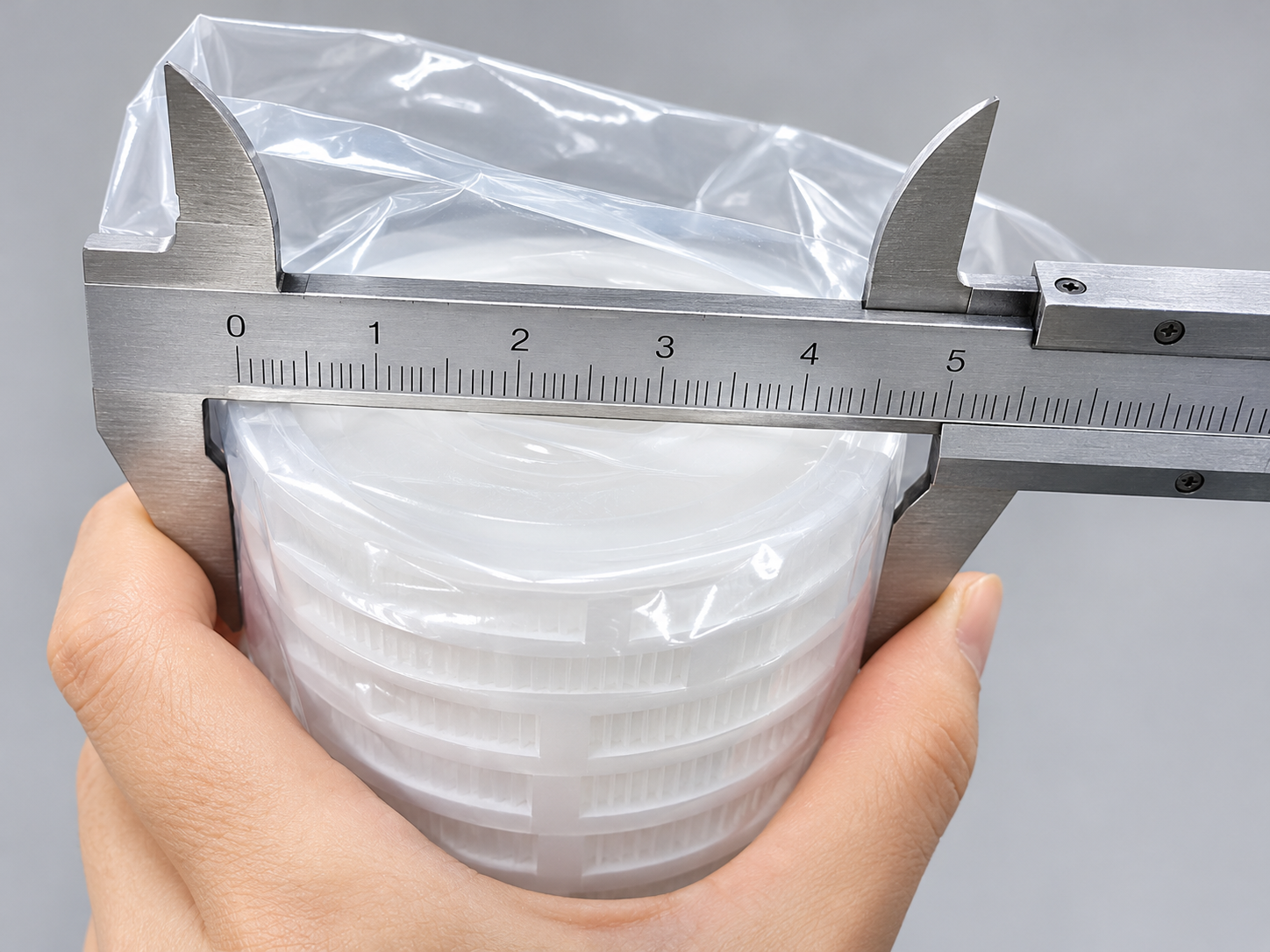
Required cartridge length and diameter
End configuration and sealing requirements
The maximum allowable differential pressure and operating temperature should also be confirmed.
Step 2: Check Physical Compatibility
Install the sample in the intended filter housing according to the equipment manufacturer's instructions.
Verify that the cartridge dimensions, end connections, and sealing surfaces match the housing.
A matching micron rating alone does not guarantee mechanical compatibility.
Step 3: Evaluate Under Actual Operating Conditions
Test the sample using the intended process fluid and operating conditions.
Depending on the application, evaluation may include:
Normal system pressure
Inlet and outlet pressure readings
Differential pressure during operation
Operating temperature
Flow rate
Seal integrity and leakage
Filtration performance
Any required pressure or performance testing should follow an agreed test procedure and acceptance criteria.
Step 4: Approve and Document the Final Specification
After satisfactory evaluation, confirm the approved cartridge configuration.
Document the final dimensions, materials, end connections, sealing arrangement, and applicable operating limits.
These records provide a technical reference for subsequent bulk production and inspection.
Sample approval should be based on documented acceptance criteria rather than visual appearance or fit alone.
6. What Information Should Buyers Provide When Requesting a 0.1 Micron PP Filter Cartridge?
Buyers should provide the filtration rating, operating pressure, maximum differential pressure requirements, cartridge dimensions, end configuration, process fluid, and operating temperature.
The following checklist can help prepare a technical inquiry.
| Required Information | Why It Matters |
| Filtration rating | Confirms the required 0.1 micron specification |
| System operating pressure | Establishes the pressure condition |
| Maximum allowable differential pressure | Defines the cartridge's mechanical pressure limitation |
| Cartridge length and diameter | Ensures housing compatibility |
| End configuration | Confirms the connection and sealing method |
| Process fluid | Supports material compatibility evaluation |
| Operating temperature | Helps evaluate operating limits |
| Flow rate | Supports pressure-drop and cartridge sizing evaluation |
| Estimated quantity | Supports sampling and quotation planning |
If possible, provide the existing housing model, technical drawing, or a sample cartridge.
Complete technical information helps reduce misunderstandings during cartridge selection and supports more accurate evaluation before ordering.
7. Frequently Asked Questions
Can a 0.1 micron PP pleated filter cartridge operate at 0.5 MPa?
Nanjing Blue Sky confirms that its specified 0.1 micron PP cartridge can be evaluated for this operating pressure. Final suitability depends on the cartridge configuration, allowable differential pressure, housing pressure rating, fluid, and temperature.
Does 0.5 MPa operating pressure mean the filter can withstand a 0.5 MPa differential pressure?
No. Operating pressure and differential pressure describe different conditions. The maximum allowable differential pressure must be confirmed separately.
Does a finer filtration rating mean the cartridge can withstand higher pressure?
No. The micron rating describes filtration characteristics. Mechanical pressure resistance depends on cartridge construction, support structure, materials, and operating conditions.
Can differential pressure increase as the cartridge becomes clogged?
Yes. At a relatively constant flow rate, particle accumulation generally increases flow resistance and differential pressure.
Is sample testing necessary before ordering 1,000 filter cartridges?
Sample testing is strongly recommended when the cartridge will be used in a specific filtration system. The sample quantity and acceptance criteria should be agreed upon before bulk purchasing.
8. Conclusion: Verify the Complete Operating Conditions Before Ordering
A 0.1 micron PP pleated filter cartridge may be suitable for a system operating at 0.5 MPa, provided the selected configuration and complete filtration system meet the required operating limits.
The most important distinction is between system operating pressure and cartridge differential pressure.
Buyers should also confirm temperature, fluid compatibility, flow rate, housing dimensions, sealing requirements, and sample performance before bulk purchasing.
Clear technical requirements and documented sample evaluation can reduce uncertainty during product selection and production.
Need Help Confirming Your Filter Cartridge Specifications?
If you are sourcing a 0.1 micron PP pleated filter cartridge for an existing filtration system, Nanjing Blue Sky Filter can review the supplied technical requirements and evaluate product suitability.
Please send:
Required filtration rating and end configuration
Operating pressure and maximum differential pressure requirements
Cartridge length and diameter, or housing drawing
Process fluid and operating temperature
Flow rate and estimated order quantity, if available
Our team can review these details and discuss the next steps for sample evaluation and quotation.
Please feel free to send your inquiry to sales@bluesky-filter.com.

If you want to see our updates in real time on social media, you can follow the following accounts.
LinkedIn: linkedin.com/company/blueskyfilter
Twitter: twitter.com/blueskyfilter
Facebook:www.facebook.com/blueskyfilter.manufacturer/
Youtube:www.youtube.com/@blueskyfilter
Instagram:https://www.instagram.com/nanjingblueskyfilters/