Which Stainless Steel Is Best for Cone Air Filter Mesh in Saltwater Environments: 201, 304 or 316
For cone air filter mesh exposed to saltwater splashes or coastal environments, 316 stainless steel is generally preferred because its molybdenum content improves resistance to chloride-induced pitting corrosion. Grade 304 may be suitable for less demanding conditions, while 201 is generally not recommended for frequent saltwater exposure. However, even 316 requires further evaluation for prolonged seawater immersion or severe chloride exposure.
For automotive air filter distributors, motorcycle and ATV parts suppliers, and OEM buyers, selecting the right stainless steel mesh involves balancing corrosion resistance, material cost, airflow, structural strength, and surface finish.
1. What Is the Function of Stainless Steel Mesh in a Cone Air Filter?
Stainless steel meThe main differences between 201, 304 and 316 stainless steel are their alloy composition, corrosion resistance, and material cost. For frequent chloride exposure, 316 is generally the strongest candidate among these th
ree grades.sh provides structural support and helps protect the filter media from external contact and mechanical damage. Depending on the filter design, it may also help maintain the shape and stability of the pleated media.
The metal mesh is commonly used as an outer protective layer or an internal supporting structure in cone air intake filters.
When selecting mesh materials, buyers should consider:
Resistance to environmental corrosion.
Wire diameter and mesh opening size.
Effective open area for airflow.
Structural strength and forming requirements.
Compatibility with the filter media and end caps.
Surface finish and appearance requirements.
The stainless steel grade primarily affects the properties of the metal component. It does not independently determine the filtration efficiency of the complete air filter.
A suitable mesh design should support the filter structure without introducing unnecessary airflow resistance.
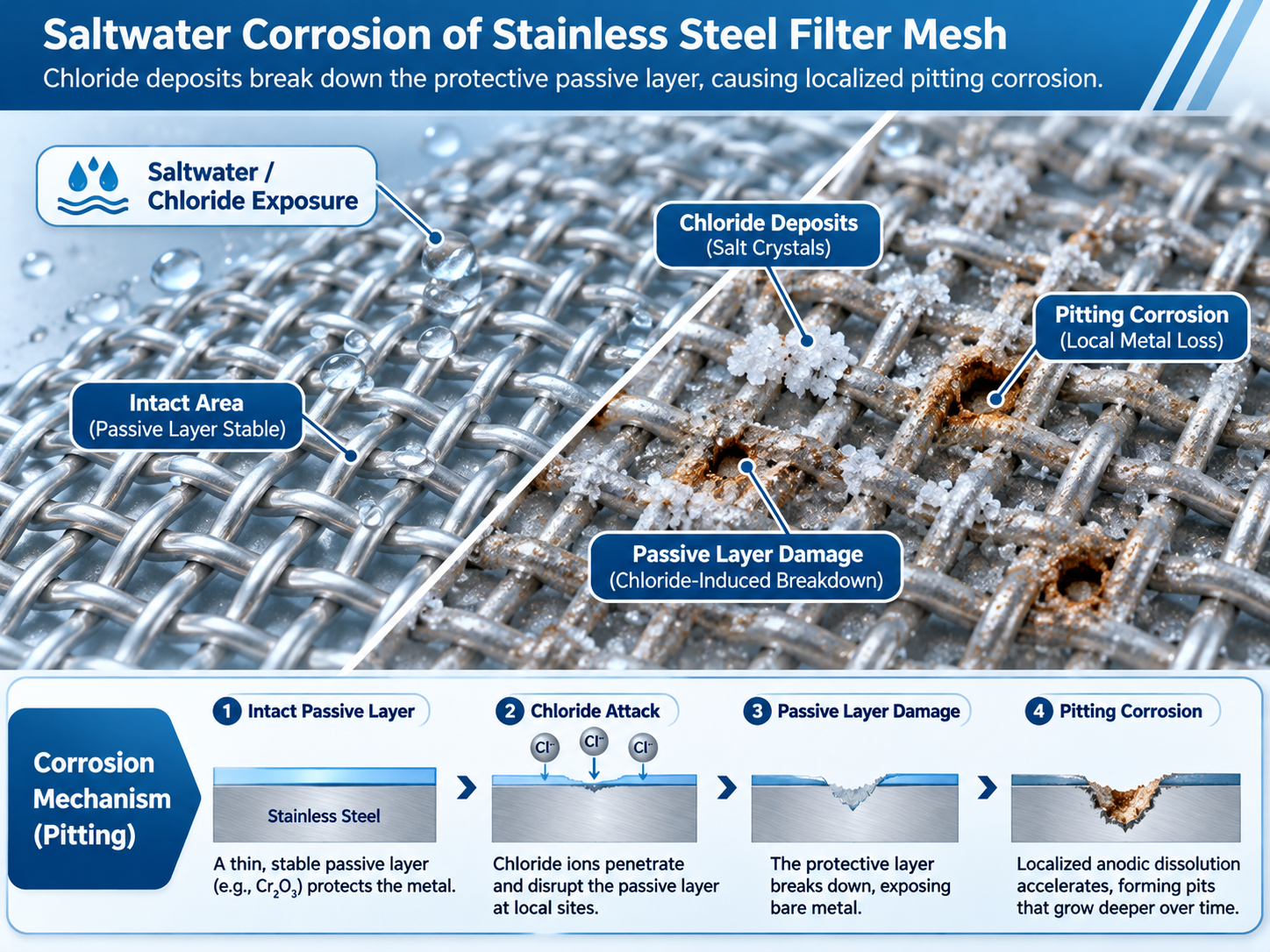
2. Why Can Saltwater Cause Corrosion in Stainless Steel Filter Mesh?
Saltwater contains chloride ions that can locally damage the protective passive layer on stainless steel, increasing the risk of pitting and crevice corrosion.
For cone air filters used in salt-exposed vehicle applications, corrosion risks may arise from:
Coastal air and salt mist.
Road de-icing salts.
Saltwater splashes.
Repeated wetting and drying.
Salt deposits remaining on the mesh surface.
Moisture trapped between mesh and other filter components.
Repeated evaporation may concentrate salt deposits on the mesh surface, creating more aggressive local conditions.
Corrosion can affect the appearance of the filter and, in more severe cases, the integrity of the metal mesh.
The actual risk depends on exposure frequency, salt concentration, temperature, surface condition, and maintenance practices.
3. What Are the Differences Between 201, 304 and 316 Stainless Steel Mesh?
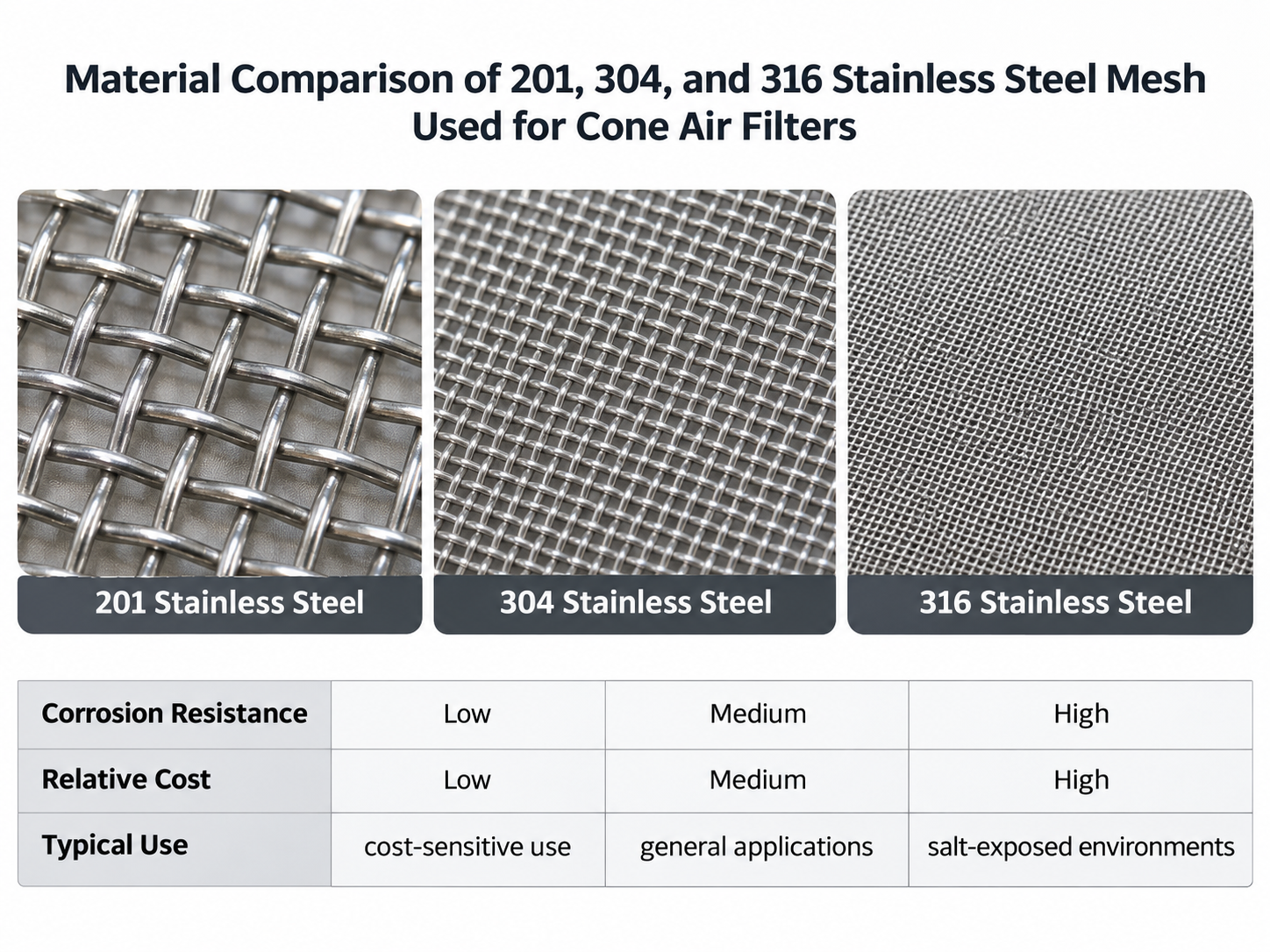
The main differences between 201, 304 and 316 stainless steel are their alloy composition, corrosion resistance, and material cost. For frequent chloride exposure, 316 is generally the strongest candidate among these three grades.
3.1 Grade 201 Stainless Steel Mesh
201 stainless steel typically uses more manganese and less nickel than 304 stainless steel.
It can be considered for cost-sensitive applications where the operating environment and corrosion requirements are not demanding.
However, 201 generally offers lower corrosion resistance than 304 and 316 under comparable chloride exposure conditions.
For cone air filters that may frequently encounter saltwater splashes or road salt, 201 should not be the default material choice without application-specific validation.
3.2 Grade 304 Stainless Steel Mesh
304 stainless steel offers good general corrosion resistance and is widely used in industrial and automotive-related components.
It may be considered for cone air filter mesh used in relatively mild environments or applications with limited chloride exposure.
However, 304 remains susceptible to localized corrosion when exposed to concentrated chloride deposits or seawater.
Buyers should evaluate the actual exposure conditions before selecting 304 for coastal or salt-exposed vehicle applications.
3.3 Grade 316 Stainless Steel Mesh
316 stainless steel contains molybdenum, which generally improves resistance to chloride-induced pitting corrosion compared with 304.
This makes it a preferred candidate for cone air filter mesh exposed to frequent salt spray, coastal air, or saltwater splashes.
However, 316 is not completely corrosion-proof. Continuous seawater contact, trapped moisture, high chloride concentration, and unsuitable surface conditions may still lead to corrosion.
Severe marine applications may require alternative materials or additional engineering evaluation.
4. 201 vs. 304 vs. 316 Stainless Steel: Technical Comparison
The following table summarizes the general material differences relevant to cone air filter mesh procurement.
| Comparison Factor | 201 Stainless Steel | 304 Stainless Steel | 316 Stainless Steel |
| Main alloy characteristics | Chromium-manganese-nickel | Chromium-nickel | Chromium-nickel-molybdenum |
| General corrosion resistance | Moderate | Good | Good |
| Relative chloride corrosion resistance | Generally lower | Intermediate | Generally higher |
| Frequent saltwater splashes | Generally not preferred | Requires careful evaluation | Preferred candidate, subject to validation |
| Continuous seawater immersion | Not recommended as a default | Not recommended as a default | Requires further engineering evaluation |
| Relative raw material cost | Typically lower | Typically intermediate | Typically higher |
| Natural appearance | Silver metallic | Silver metallic | Silver metallic |
| Black painted finish | Feasibility depends on coating and substrate | Can be evaluated | Can be evaluated |
| Airflow characteristics | Depends on mesh geometry | Depends on mesh geometry | Depends on mesh geometry |
These comparisons are general material selection guidelines rather than product-specific test results.
The finished filter's corrosion performance also depends on mesh dimensions, manufacturing quality, surface treatment, and the complete filter assembly.
5. Which Stainless Steel Grade Should Buyers Choose for Different Operating Environments?
Material selection should be based on the actual type and severity of salt exposure rather than simply specifying a higher stainless steel grade.
General Road Conditions
For vehicles operating in relatively mild environments, 304 stainless steel may provide a suitable balance between material cost and corrosion resistance.
Grade 201 may also be considered for less demanding, cost-sensitive applications if its performance meets the agreed requirements.
Coastal Air and Occasional Salt Exposure
For vehicles operating near coastal areas or occasionally exposed to road salt, buyers should compare 304 and 316 according to exposure frequency, maintenance conditions, and expected product performance.
Frequent Saltwater Splashes
For vehicles regularly exposed to saltwater splashes, 316 is generally the preferred starting point among the three grades.
The complete filter design should still be evaluated, particularly where salt deposits or moisture may remain trapped.
Prolonged Seawater Contact
Neither 304 nor 316 should be assumed suitable for prolonged seawater immersion without further evaluation.
In addition, improving the corrosion resistance of the mesh does not make the complete cone air filter waterproof or suitable for submerged operation.
| Operating Environment | Material Selection Direction |
| Mild, low-chloride conditions | 201 or 304, subject to validation |
| General automotive applications | 304 may be considered |
| Coastal air and occasional salt exposure | Evaluate 304 and 316 |
| Frequent saltwater splashes | Prioritize evaluation of 316 |
| Prolonged seawater immersion | Application-specific engineering review |
Buyers should provide a clear description of the intended operating environment when requesting material recommendations.
6. Why Is 316 Stainless Steel Mesh More Expensive Than 304?
316 stainless steel generally costs more than 304 because of its alloy composition, including the addition of molybdenum.
However, the total cost of a customized cone air filter mesh is not determined by stainless steel grade alone.
Other factors may include:
Wire diameter and mesh opening size.
Mesh construction and material consumption.
Filter dimensions and forming requirements.
Cutting, joining, and assembly processes.
Surface treatment and coating requirements.
Order quantity and production arrangements.
For wholesale buyers, the appropriate comparison is the cost of the complete filter configuration rather than the raw material price alone.
If 304 meets the required corrosion performance, it may provide a more economical solution. If the application involves frequent chloride exposure, the additional cost of 316 may be justified by the required corrosion resistance.
The final decision should consider both purchasing cost and expected operating conditions.
7. Can 304 and 316 Stainless Steel Filter Mesh Have a Black Finish?
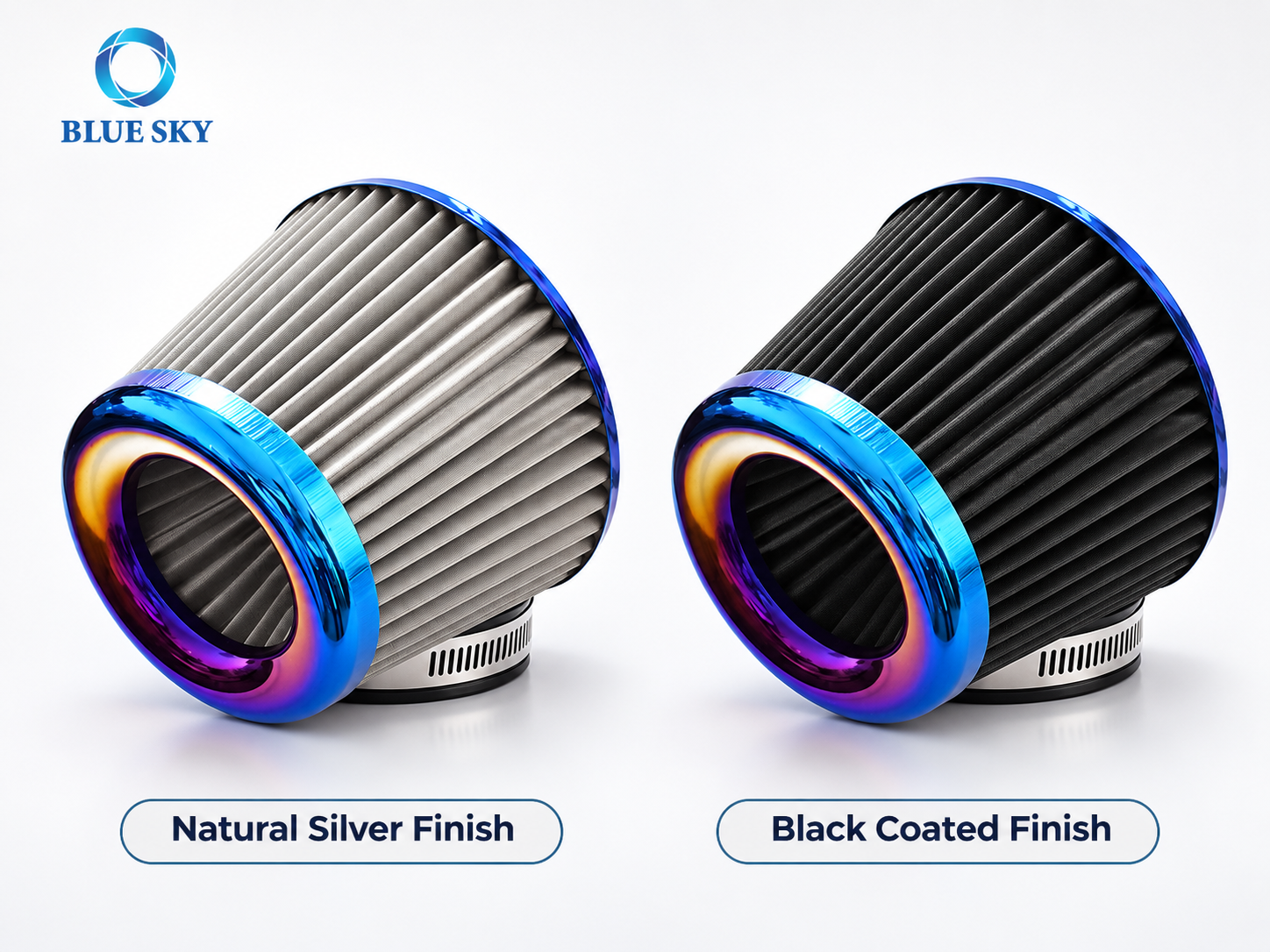
Yes. Both 304 and 316 stainless steel mesh can be evaluated for a black painted finish. However, the coating process must be compatible with the metal substrate, mesh geometry, and airflow requirements.
The natural appearance of both grades is metallic silver.
A black surface finish may be required for product appearance, private-label differentiation, or consistency with an existing air intake design.
7.1 Surface Preparation and Coating Adhesion
Appropriate surface cleaning and preparation are important for coating adhesion.
Buyers should discuss the required coating type, appearance, and durability before approving the sample.
7.2 Mesh Opening Size and Airflow
Excessive coating thickness or paint buildup may partially block mesh openings and reduce the available open area.
For air intake filters, the coating process should therefore be evaluated together with the mesh dimensions and airflow requirements.
7.3 Corrosion Resistance of the Finished Mesh
A black coating should not be treated as an automatic substitute for selecting an appropriate stainless steel grade.
The corrosion performance of the coated mesh depends on the substrate, coating properties, surface preparation, coverage, and actual operating conditions.
Buyers should confirm coating adhesion and corrosion performance using appropriate evaluation methods where required.
8. What Should Buyers Verify Before Upgrading Cone Air Filter Mesh to 316?
An upgrade from 201 or 304 to 316 stainless steel should include an evaluation of material availability, mesh geometry, manufacturing compatibility, airflow, and corrosion requirements.
Using the same mesh dimensions does not automatically establish that the upgraded component can be manufactured or assembled without adjustments.
Before approving a customized mesh, buyers should confirm the following specifications.
| Specification | Why It Matters |
| Stainless steel grade | Defines the required base material |
| Mesh construction | Identifies the required woven, expanded, or other mesh structure |
| Wire diameter or strand thickness | Influences structural and airflow characteristics |
| Mesh opening size | Affects open area and media protection |
| Effective open area | Supports airflow evaluation |
| Cone filter dimensions | Determines forming and assembly requirements |
| Joining and attachment method | Supports structural compatibility |
| Natural or black finish | Defines appearance and coating requirements |
| Operating environment | Establishes corrosion exposure conditions |
| Estimated order quantity | Supports manufacturing feasibility and quotation |
The complete filter assembly should also be reviewed, including the filter media, end caps, clamps, and other metal components.
Upgrading the mesh to 316 does not automatically upgrade the corrosion resistance of every other component.
9. How Can Buyers Verify Stainless Steel Mesh Material and Corrosion Performance?
Buyers should request appropriate material documentation and, where necessary, evaluate representative finished mesh or filter samples under agreed corrosion and airflow test conditions.
Material grade can be checked using supplier material documentation or suitable material identification methods.
For applications with specific corrosion requirements, buyers may also request an agreed corrosion test procedure, such as a salt spray test where appropriate.
The evaluation should clarify:
Required stainless steel grade.
Material documentation requirements.
Applicable test method.
Test duration and acceptance criteria.
Coating adhesion requirements, if applicable.
Airflow or pressure-drop evaluation requirements.
A salt spray test result should not be directly converted into a guaranteed service life in actual vehicle operation.
Sample evaluation should focus on the finished mesh and its intended use rather than relying only on the theoretical properties of the stainless steel grade.
10. Frequently Asked Questions
Can cone air filter mesh be manufactured from 201 stainless steel?
Yes, 201 may be considered for suitable low-corrosion applications. However, it is generally not preferred for frequent saltwater exposure, where 304 or 316 may offer better corrosion resistance.
Is 316 stainless steel better than 304 for salt-exposed air filters?
Generally, yes. The molybdenum content in 316 improves resistance to chloride-induced pitting corrosion. Final suitability still depends on the actual exposure conditions and finished mesh design.
Can 316 stainless steel rust or corrode in seawater?
Yes. Although 316 has better chloride corrosion resistance than 304, it can still experience pitting or crevice corrosion, particularly under prolonged seawater exposure or unfavorable surface conditions.
Can 316 stainless steel mesh be painted black?
Yes. A black painted finish can be evaluated for 316 stainless steel mesh. Coating adhesion, coverage, durability, and the effect on mesh openings should be verified.
Will changing from 304 to 316 mesh affect air filter performance?
Changing the stainless steel grade alone does not necessarily change filtration efficiency or airflow. However, changes in mesh geometry, wire dimensions, open area, coating thickness, or filter construction may influence the finished filter's performance.
Can an existing cone air filter design be upgraded to 316 stainless steel mesh?
Potentially, yes. The feasibility depends on material availability, mesh construction, forming requirements, attachment methods, and the complete filter design. An original sample or drawing can support the initial evaluation.
11. Conclusion: Choose Stainless Steel Mesh According to the Actual Application
For cone air filter mesh exposed to saltwater splashes or frequent chloride exposure, 316 stainless steel is generally the preferred candidate among 201, 304, and 316.
Grade 304 may offer a more economical solution for less demanding environments, while 201 should be evaluated carefully where corrosion resistance is important.
The final material choice should also consider mesh geometry, airflow, structural support, coating requirements, and the corrosion performance of the complete filter assembly.
Need a Custom Cone Air Filter with Stainless Steel Mesh?
Nanjing Blue Sky Filter can review customization requirements for cone air filters and related metal mesh components.
To help us evaluate your project, please provide:
Original filter photos, samples, or technical drawings.
Required filter dimensions and mesh specifications.
Preferred stainless steel grade: 201, 304, or 316.
Natural silver or black surface finish requirements.
Vehicle application and expected salt exposure conditions.
Required corrosion testing specifications, if applicable.
Estimated order quantity.
Our team can review the material, structural, and appearance requirements and evaluate a suitable manufacturing approach before sample development or quotation.
Please feel free to send your inquiry to sales@bluesky-filter.com.
If you want to see our updates in real time on social media, you can follow the following accounts.
LinkedIn: linkedin.com/company/blueskyfilter
Twitter: twitter.com/blueskyfilter
Facebook: www.facebook.com/blueskyfilter.manufacturer/
Youtube: www.youtube.com/@blueskyfilter
Instagram: https://www.instagram.com/nanjingblueskyfilters/